
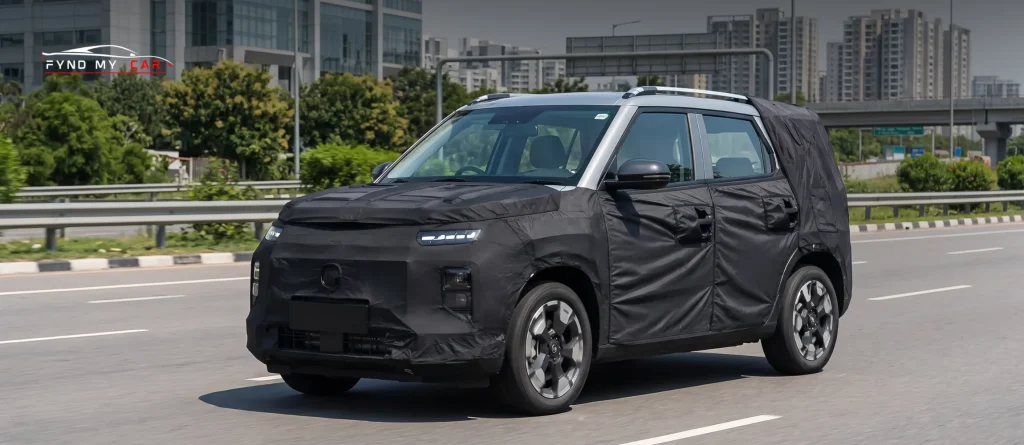
Are you waiting for an electric SUV that does not burn a hole in your pocket? Then Hyundai may have some good news for you.
The company is working on a small, India-made electric SUV codenamed HE1i. It will sit below the Creta Electric and aim at everyday buyers. Many people are asking about the Hyundai electric SUV’s December 2026 launch, but the date is still not fixed.
In this article, we cover the expected price, range, battery, features, rivals, and launch timing in simple terms, so you can plan your next car with confidence.
Hyundai HE1i Electric SUV at a Glance
Here is a simple snapshot of what is known so far. Remember, Hyundai has not announced final numbers yet, so many of these points come from reports and test-car sightings.
| Point | Details |
| Codename | HE1i (final name not confirmed) |
| Body type | Compact electric SUV, under 4 metres |
| Platform | E-GMP (K), the same base as the overseas Inster EV |
| Built at | Sriperumbudur, Tamil Nadu |
| Expected price | Roughly ₹10 lakh to ₹16 lakh (ex-showroom) |
| Battery options | Standard Range and Long Range |
| Expected launch | Late 2026 to early 2027 |
| Main rival | Tata Punch EV |
What Exactly Is the Hyundai HE1i?
The HE1i is Hyundai’s first electric car designed mainly for Indian roads and Indian budgets. Hyundai India’s CEO, Tarun Garg, has called it the first EV developed and designed for India. Until now, Hyundai’s electric cars here have been costly. The Ioniq 5 and the Creta Electric are great cars, but not everyone can afford them. The HE1i is meant to fix that gap. Think of it as Hyundai’s answer for first-time EV buyers and city families. It is also easy to mix it up with another upcoming car. The Bayon is a separate petrol SUV. The HE1i is the electric one.
Why Hyundai Needs This Car?

Electric cars made up about 7 percent of passenger vehicle sales in India recently. At Hyundai, the share was only around 1 percent in the last financial year. That is a big difference. Hyundai wants to change it fast. Reports say the company hopes EVs will cross 7 percent of its Indian sales within a year of this launch. A cheaper, smaller EV is the easiest way to get there. Local production also helps. Hyundai plans more than 50 percent local content, which can keep costs under control.
Hyundai HE1i Launch Date: What Do We Really Know?
This is where things get a little confusing. Different reports give different timelines, and Hyundai has not announced an exact date.
| Source of information | Timeline |
| Hyundai Investor Day plan | By March 2027 |
| Hyundai India CEO | By the end of 2026 |
| Some media reports | November or December 2026 |
| Other media reports | January 2027 |
| Latest reports | First quarter of 2027, maybe at the Bharat Mobility Expo in February |
So what should you believe? The safest answer is this: Hyundai has promised the car within the current financial year, which ends in March 2027.
Will the Hyundai Electric SUV Come in December 2026?
If you are searching for Hyundai electric SUV December 2026, here is the honest picture. Some reports point to a December 2026 unveiling or arrival, and the CEO has said: “by the end of 2026.” But there is no official date yet. Battery supply changes have also caused some talk of delays. A debut in December is possible, though a showroom launch and deliveries may come only in early 2027. My advice: do not book any other car in a hurry. Wait for Hyundai’s official announcement.
Hyundai HE1i Expected Price in India
Hyundai has not shared any price. Every number you see online is an estimate. Still, we can make a smart guess from the segment.
| Estimate | Expected ex-showroom price |
| Most common estimate | Around ₹10 lakh (starting) |
| Wider range in reports | ₹10 lakh to ₹16 lakh |
| Another careful estimate | ₹12 lakh to ₹15 lakh |
Why such a wide range? The price will depend on the battery size, the variant, and the features. A base trim may stay near ₹10 lakh, while a Long Range top model could go well above ₹14 lakh.
Could This Be a Hyundai Affordable Electric SUV?
Yes, that is exactly the plan. If Hyundai prices it well, this could become the brand’s most affordable electric SUV in India. Here is what helps keep the price down:
- Local manufacturing at Sriperumbudur
- High local content, above 50 percent
- A compact size, under 4 meters
- A smaller battery in the Standard Range version
- Early use of imported cells, which avoids waiting for local supply
However, price also depends on the battery. Imported cells can add cost, so Hyundai’s final pricing will be the biggest thing to watch.
Hyundai HE1i Battery: What to Expect?
The Hyundai HE1i battery is one of the most talked-about topics, but Hyundai has not officially shared battery size or chemistry. Here is what reports say.
- Two options: Standard Range and Long Range
- Early cars will use cells from Svolt, a Chinese supplier
- Reports suggest these may be LFP (lithium iron phosphate) cells
- Hyundai wanted local Exide cells, but supply delays forced a change
- Local cells may come later, when the supplier is ready
The overseas Inster EV uses 42 kWh and 49 kWh packs. The HE1i could use similar sizes, but this is only a guess. Treat these as reference points, not final specifications.
Why LFP Cells Matter for You?
If the HE1i does use LFP cells, that is good news for most buyers. LFP batteries are known for a few things:
- They are usually safer and handle heat well
- They tend to last longer over many charge cycles
- They cost less than many other battery types
- They are fine for daily city use
The one small downside is that LFP packs can be slightly heavier for the same energy. For a city SUV, this is rarely a big problem.
Hyundai HE1i Range: How Far Will It Go?
Now let us talk about the Hyundai HE1i range. Hyundai has not announced a certified figure yet, and reports vary a lot.
| Source of estimate | Range claim |
| Inster reference (Standard) | Up to 327 km (WLTP) |
| Inster reference (Long Range) | Up to 370 km (WLTP) |
| Some early reports | 300 km to 355 km |
| Other reports | Around 450 km to over 500 km |
Why the big gap? Different tests give different numbers. India’s own test method often shows a higher figure than the real-world result. So a 450 km claim on paper could mean roughly 300 km to 350 km in daily driving.
Real-World Range: A Simple Rule
Here is an easy way to think about it. Take the claimed range and expect around 70 to 75 percent in real life. Highway speed, air conditioning, heavy traffic, and passengers will all reduce it. For city use, even 250 km on a full charge is enough for most families. You can drive to work and back for several days before you need to plug in.
Charging Speed and Time
Hyundai’s test cars have been spotted at public fast chargers. Reports say the HE1i has been tested with up to 120 kW DC fast charging. That does not prove the final car will accept 120 kW, but it is a good sign. If it does, a 10 to 80 percent charge could take well under an hour. For home charging, a normal wall box would charge it overnight. Most owners will do this, and it keeps running costs very low.
Design: Small Size, Tough Look
Spy photos show a boxy, upright body with good ground clearance. The roof rails sit high, which gives it a rugged feel. Slim, modern headlamps and tail lamps add a futuristic touch. It will be under 4 meters long, so it fits easily in tight city lanes and small parking spots. The squarish shape should also give decent cabin room for its size. Some test cars have shown different headlamp layouts, so the final design may change a little.
Expected Features Inside
Hyundai has confirmed two big things: a next-generation infotainment system and Level 2 ADAS (advanced driver assistance). Beyond that, reports suggest more.
- Pleos Connect infotainment, with a big screen of around 17 inches
- A new interior design style shared with future Hyundai cars
- Level 2 driver assistance, such as lane keep and adaptive cruise
- Connected car features through a phone app
- Multiple airbags and modern safety tech
Do not expect everything on the base variant. Hyundai usually keeps the best features for higher trims, so check the variant list when it is announced.
Safety: Something to Watch
Driver-assist tech is great, but it does not replace a strong body. Buyers should wait for the crash-test rating before deciding. A good safety score will matter a lot here, because many first-time EV buyers are families. Look for the number of airbags in the base variant and for the official rating once it is available.
Hyundai HE1i vs Tata Punch EV
This is the match everyone wants to see. The Hyundai HE1i vs Tata Punch EV battle will decide who rules the small electric SUV space. The Punch EV is the proven choice, while the HE1i is the new challenger.
| Point | Hyundai HE1i (expected) | Tata Punch EV |
| Price | ₹10 lakh to ₹16 lakh (estimate) | About ₹9.69 lakh to ₹12.59 lakh |
| Battery | Standard and Long Range (unconfirmed) | Two battery options |
| Range | 300 km to 450 km (reports vary) | Claimed range varies by variant |
| Fast charging | Up to 120 kW (reported) | Fast charging available |
| Driver assist | Level 2 ADAS (confirmed) | Depends on the variant |
| Infotainment | Pleos Connect (reported) | Large touchscreen |
| Availability | Not launched yet | On sale now |
The Punch EV has one big advantage: you can buy it today. The HE1i may win on tech, ADAS, and fresh design, but it needs a sharp price.
Other Rivals to Keep in Mind
The HE1i won’t just fight the Punch EV. Depending on its final price, it may also take on slightly bigger electric SUVs.
- Tata Nexon EV
- Mahindra XUV 3XO EV
- Kia Syros EV
- Citroen eC3 and other small EVs
If Hyundai prices the Long Range version above ₹14 lakh, it will start to face these bigger cars. That is why the price matters so much.
Pros and Cons Based on Current Information
Here is a balanced view of what looks good and what still worries us.
What looks good:
- Made in India for Indian roads
- Likely to be Hyundai’s cheapest EV
- Level 2 ADAS is confirmed
- Two battery choices
- Fast-charging tests are already on
What still needs clarity:
- No official price yet
- No confirmed battery size or range
- Launch date is still uncertain
- Early cars depend on imported cells
- Safety rating is not known yet
Should You Wait for the HE1i?
It depends on your needs. If you need a car right now, buy what suits you today. A proven EV already on sale is a safe choice. But if you can wait two to four months, the HE1i is worth watching. Hyundai has a strong service network, and its cars are known for good features. A well-priced HE1i could shake up the segment. My simple tip: wait for the official price and range, then compare it with the Punch EV before booking.
Final Thoughts
Hyundai HE1i could be a major milestone for Hyundai. This car could help them present their EV tech to a much broader audience. If priced in the ₹10 lakh to ₹14 lakh range and offering a reasonable range, it could become an excellent option for city households. However, nothing is confirmed yet. We have to wait until Hyundai announces the launch date, battery, price, and other details. Keep an eye on the updates in the coming weeks.
FAQs
1. When will the Hyundai HE1i launch in India?
A. A. There is no official date. Hyundai plans a debut by March 2027, and the CEO has said it could arrive by the end of 2026. Some reports point to December 2026, while others say January or the first quarter of 2027.
2. What is the expected price of the Hyundai HE1i?
A. A. Estimates range from about ₹10 lakh to ₹16 lakh (ex-showroom). A more careful guess is ₹12 lakh to ₹15 lakh. Hyundai has not confirmed any price yet.
3. What will be the range of the Hyundai HE1i?
A. A. Hyundai has not announced it. The related Inster EV offers up to 327 km and 370 km (WLTP). Some reports claim 450 km or more. Real-world range is usually lower than the claimed figure.
4. Will the HE1i have ADAS and fast charging?
A. A. Hyundai has confirmed Level 2 ADAS and a next-generation infotainment system. Test cars have been seen charging at up to 120 kW, but the final charging speed is not confirmed.
5. Is the HE1i better than the Tata Punch EV?
A. A. It is too early to say. The HE1i may offer newer tech and ADAS, but the Punch EV is already on sale with a known price. Compare both once Hyundai reveals the final price and range.