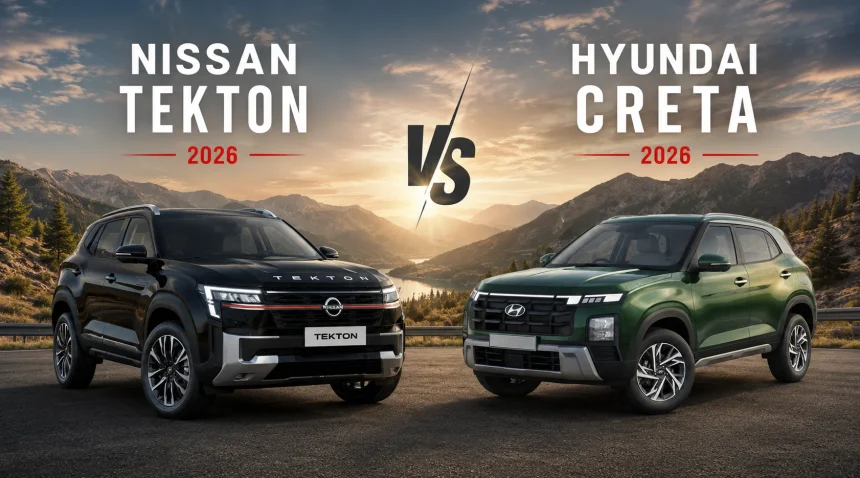
Thinking of buying a new SUV but can’t decide between the newcomer and the segment king? That’s exactly the dilemma many Indian car buyers are facing right now.
For years, the Hyundai Creta has been the car everyone points to when they say midsize SUV. It’s sold in huge numbers, it’s easy to get serviced, and resale value has never been a headache. But Nissan has just thrown its hat in the ring with the Tekton, a fresh, boldly styled SUV built in Chennai with Renault, and it’s already turning heads.
In other words, does it pay off to pick the newbie over the trusted classic? It is time to see how the Nissan Tekton competes against the Hyundai Creta in simple terms.
Nissan Tekton vs Hyundai Creta: Full Specification Comparison
| Parameter | Nissan Tekton | Hyundai Creta |
| Price Range (ex-showroom) | ₹10.49 lakh – ₹18.59 lakh | ₹10.73 lakh – ₹20.11 lakh |
| Variants | Visia, Visia Plus, Acenta, N-Connecta, Tekna, Tekna Plus | E, EX, EX(O), S(O), SX, SX Premium, Knight, King, N Line |
| Engine Options | 1.0L turbo-petrol, 1.3L turbo-petrol | 1.5L petrol, 1.5L turbo-petrol, 1.5L diesel |
| Power Output | 100 PS (1.0L) / 163 PS (1.3L) | Up to ~158 PS (turbo-petrol) |
| Torque | 166 Nm (1.0L) / 280 Nm (1.3L) | Up to ~253 Nm (turbo-petrol) |
| Transmission | 6-speed MT, 6-speed DCT | 6-speed MT, CVT/IVT, 7-speed DCT, 6-speed AT (diesel) |
| Mileage (ARAI-claimed) | 17.8–19.4 kmpl | 17.4–21.8 kmpl |
| Length | 4,348 mm | 4,330 mm |
| Width | 1,815 mm | 1,790 mm |
| Height | 1,674 mm | 1,635 mm |
| Wheelbase | 2,657 mm | 2,610 mm |
| Boot Space | 700 litres | 433 litres |
| Sunroof | Panoramic sunroof | Panoramic sunroof |
| Touchscreen | 10.1-inch, wireless Android Auto/Apple CarPlay | 10.25-inch, wireless Android Auto/Apple CarPlay |
| Digital Cluster | 10.25-inch | 10.25-inch |
| Ventilated Seats | Yes (front, powered) | Yes (select variants) |
| Airbags | 6 | 6 |
| ADAS | Level 2 | Level 2 (select variants) |
| 360-Degree Camera | Yes | Yes |
| Crash Test Rating | 5-star Bharat NCAP | Not tested by Bharat NCAP (3-star GNCAP, older test) |
Nissan Tekton Price vs Hyundai Creta Price 2026
Money talks first, so let’s get straight into it. The Nissan Tekton starts at around Rs 10.49 lakh (ex-showroom) and goes up to Rs 18.59 lakh for the fully loaded Tekna Plus variant with the 1.3-liter DCT engine. In between, you get variants like Visia, Visia Plus, Acenta, N-Connecta, and Tekna, six trims in total, so there’s something for almost every budget.
The Hyundai Creta price 2026 isn’t too far off at the entry level. It kicks off around Rs 10.73 lakh and climbs to roughly Rs 20.11–20.20 lakh for the top-spec SX(O) or King trims. But here’s the thing. Hyundai offers a mind-boggling number of variants (well over 40 when you count every engine and gearbox combination), so there’s a lot more flexibility if you want to fine-tune your purchase to the last rupee.
Quick price verdict: In the entry variants, both are evenly matched, with only around Rs 30,000 separating them. But once you reach the upper rungs of the variant range, the pricing of the Creta becomes increasingly higher due to the fact that it has diesel variants as well. On account of being better value for money, the Tekton wins. On the other hand, the Creta scores due to offering a wider range of variants.
Engine and Performance: Tekton vs Creta Comparison
And here’s when things start getting really fun! The Nissan Tekton provides us with just two turbo petrol engines. The smaller one is a 1.0-liter engine producing 100PS with torque output of 166Nm along with a 6-speed manual transmission, and the bigger one is a 1.3-liter engine delivering 163PS with 280Nm torque and available with manual or DCT transmission.
The Hyundai Creta, on the other hand, plays a much wider game. You get a 1.5-liter naturally aspirated petrol (115 PS/144 Nm), a 1.5-liter turbo-petrol (160 PS/253 Nm), and a 1.5-liter diesel (116 PS/250 Nm). Gearbox options include a 6-speed manual, iMT, CVT, torque converter automatic, and a 7-speed DCT, depending on which engine you pick.
Performance take: If you want outright punch without paying diesel prices, the Tekton’s 1.3-liter turbo is genuinely quick and feels eager on the highway. But if you rack up big kilometers every month and want a diesel option, the Creta is the only one of the two that offers it. City drivers who just want a smooth, no-fuss automatic will be happy either way, though the Creta’s diesel-automatic combo is still unmatched in this comparison.
Mileage Comparison
The efficiency of fuel will be the major concern of buyers during practical calculations. Nissan Tekton petrol cars claim to give a fuel efficiency of approximately 19.4 kmpl, which is an impressive figure for a turbo-petrol SUV in this category.
Mileage of the Hyundai Creta varies widely depending on engine choice, ranging from 17.4 kmpl to 21.8 kmpl. Mileage of diesel automatic and CVT petrol versions usually falls on the higher end of the spectrum, while the turbo-petrol DCT is thirstier.
Mileage verdict: For pure petrol efficiency, the two are fairly close, with the Creta’s naturally aspirated variant having a slight edge in claimed figures. But if long-distance, high-mileage driving is your priority, the Creta diesel remains the more sensible choice simply because the Tekton doesn’t offer a diesel at all right now.
Dimensions: Which SUV Is Bigger?
Size does matter when it comes to family comfort and boot capacity. According to the technical comparison from the respective manufacturers, the Tekton is, in fact, a slightly larger vehicle. It is about 19mm longer, 25mm wider, and has a wheelbase that is 47mm longer than the Creta. It also rides 22 mm higher above road level, which is helpful when traveling over rough patches and during heavy monsoons. The part where the Tekton scores over the Creta is boot capacity. The former has a capacity of up to 518 liters.
Dimension verdict: The Tekton does have the edge on paper, with extra cabin space, improved ground clearance, and increased luggage storage. The Creta is definitely not small, but if space is the primary consideration, the Tekton wins out here.
Interior and Cabin Experience
Get into the Nissan Tekton, and you will find a contemporary dashboard setup, including a 10.1-inch Tek-Link infotainment display with Google integration. In other words, Google Maps, Google Assistant, and Google Play Store are already included in the system and do not require mirroring from a smartphone. The passenger compartment is spacious due to the panoramic sunroof and is equipped with an air purifier and an automatic tailgate.
The Hyundai Creta counters with a cabin that’s been refined over multiple generations. Higher trims get dual 10.25-inch screens (one for infotainment, one for the digital instrument cluster), a Bose sound system, ventilated front seats, and Hyundai’s Bluelink connected-car tech. The overall fit and finish still feels a notch more premium in places, which isn’t surprising given how long Hyundai has had to polish this cabin.
Cabin verdict: The Tekton feels like a fresh and technologically advanced car, whereas the Creta seems mature and reliable, using better materials and having a design that people who are used to Hyundai cars can understand.
Feature Comparison
Both vehicles are well equipped, but they display the equipment in slightly different ways. For example, the Tekton distinguishes itself with an air purifier, powered tailgate, and fog lamps on both the front and back sides. These might be small aspects, but they can make the lives of people driving these cars a bit easier. On the other hand, the Creta offers a larger infotainment screen and additional equipment.
Both offer panoramic sunroofs, wireless smartphone connectivity, ventilated seats on higher trims, ambient lighting, and connected car technology. It’s genuinely close here. Neither car feels like it’s skimping on the essentials.
Safety Comparison
This is perhaps the most important one for buyers in India in 2026, and possibly the best place to highlight the strength of the Tekton. The Nissan Tekton is equipped with 6 airbags and has received a 5-star rating from Bharat NCAP.
The Hyundai Creta also offers 6 airbags, ABS with EBD, electronic stability control, hill-start assist, ISOFIX child seat mounts, and Level 2 ADAS (adaptive cruise control, automatic emergency braking, lane keep assist) on select variants. However, its Global NCAP rating dates back to an older test on a lower-spec version and stands at 3 stars, even though the current facelifted car with more safety kit would likely score higher if it were tested again today.
Safety verdict: Both SUVs are well-equipped with airbags and driver-assist features, but the Tekton’s newly earned 5-star rating gives it a psychological edge over the Creta’s older, lower-scoring crash test result. Even if the real-world safety gap may not be as wide as the numbers suggest.
Ride Quality and Driving Experience
While driving on the highway, the Tekton comes across as planted and stable, while its additional ground clearance makes it more confident about handling potholes and speed breakers. The Tekton comes with steering that feels light on the road, then settles down once one gets onto the highway. On the other hand, the Creta has benefited from being in existence for a few years now and from several years of suspension tuning. This makes it feel like an old acquaintance.
Nissan Tekton vs Hyundai Creta: Which SUV Should You Buy?
Buy the Nissan Tekton if:
- You want a fresh, modern SUV with sharp pricing
- You value outright space, boot capacity, and top-tier crash safety
- You’re comfortable trying a newer name in the market
- Turbo-petrol performance is more important to you than diesel
Buy the Hyundai Creta if:
- You want a proven product with strong resale value
- You need a diesel engine for high daily running
- You prefer Hyundai’s larger and more established service network
- You want the widest possible choice of variants and trims
Final Verdict
The Nissan Tekton vs Hyundai Creta battle isn’t a one-sided story anymore. The Tekton has genuinely shaken things up with its size, safety rating, and value-for-money pricing, while the Creta continues to lean on its reputation, variety, and years of proven reliability. In this midsize SUV comparison India buyers have been waiting for, there’s no universally “correct” answer. It really comes down to whether you value fresh thinking and space (Tekton) or dependability and choice (Creta).
FAQs
1. Which SUV is more affordable: Nissan Tekton or Hyundai Creta?
A. The Creta’s diesel and CVT petrol variants offer the widest efficiency range (up to 21.8 kmpl), while the Tekton’s petrol claims around 19.4 kmpl. For low running, either works well; for high running, the Creta diesel has the edge.
2. Which SUV offers better mileage?
Far far away, behind the word mountains, far from the countries Vokalia and Consonantia, there live the blind texts. Separated they live in Bookmarksgrove right at the coast of the Semantics, a large language ocean.
3. Is the Nissan Tekton bigger than the Hyundai Creta?
A. Yes, the Tekton is slightly longer, wider, and has a bigger wheelbase and ground clearance, along with a noticeably larger boot in its top trim.
4. Which SUV has better features?
A. Both are well-loaded. The Tekton adds an air purifier and powered tailgate, while the Creta counters with a bigger dual-screen setup and a premium Bose audio system.
5. Which SUV is safer?
A. The Tekton currently holds a 5-star Bharat NCAP rating, while the Creta’s Global NCAP score is older and lower, though its current safety kit list is still comprehensive.