What if the car you’ve been eyeing for months suddenly showed up at the dealership wearing a completely different badge? That’s exactly the situation Tata Tigor buyers found themselves in this September.
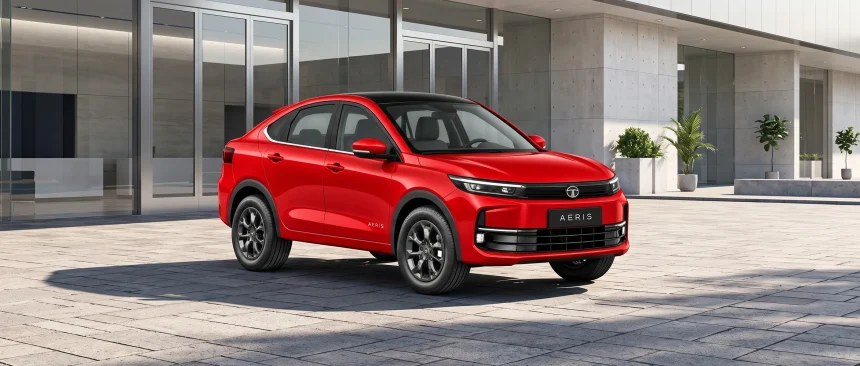
It took almost a decade for the Tigor to evolve into an Aeris, but Tata finally got around to it, and the Tigor is now called the Tata Aeris. And it is not just the name. Tata has gone ahead and revamped its design, interior, and features completely.
What Is the Tata Aeris?
The Tata Aeris is, in simple terms, the third-generation facelift of the Tata Tigor. Tata’s sub-4-meter notchback sedan that first arrived in 2017. Rather than calling this update “Tigor facelift 2026,” Tata chose to retire the Tigor name altogether and launch the car fresh as the Aeris. It sits above the Tiago hatchback in Tata’s passenger vehicle lineup and continues to compete in the compact sedan space alongside the Dzire, Aura, and Amaze. The Tata Aeris launch date is officially September 25, 2026, with bookings and full pricing confirmed the same day at dealerships across India.
Tata Aeris Explained: Key Facts At A Glance:
| Aspect | Detail |
| Segment | Sub-4m compact sedan |
| Replaces | Tata Tigor |
| Launch date | September 25, 2026 |
| Body style | Notchback sedan |
| Platform | Tata X1 (shared with Tiago) |
| Fuel options | Petrol, CNG, and EV (expected) |
Why Tata Renamed the Tigor?
The company’s move to strip away a brand name it had used for nine years was no accident. Several factors drove this choice.
- Fresh brand positioning: The Tigor name carried a slightly dated, budget-sedan image. Aeris signals a more premium, modern identity.
- Aligning with Tiago’s design language: The car now borrows heavily from the recently updated Tiago facelift, so a shared naming refresh makes sense.
- Standing out in a shrinking segment: With only four real players left in sub-4m sedans, Tata wants the Aeris to feel distinct rather than “just another Tigor update.”
- Marketing reset: A new name lets Tata launch a louder campaign. Its teaser line “Bye Bye Boring, Hello Stunning” reflects this intent.
In short, this is less about the mechanicals and more about giving the sedan a second life with buyers who may have written off the Tigor.
What Changes Over the Tigor (Design, Cabin, Features)?
This is where the Tata Tigor facelift turns into something that looks genuinely new rather than a mild update. Tata has revised nearly every visible panel.

Exterior changes:
- Slimmer, rectangular LED headlamps with integrated DRLs and a sharp horizontal light signature
- Redesigned front bumper with a larger lower air intake and slimmer grille
- New LED tail lamps with connected styling and “AERIS” lettering across the tailgate
- Fresh U-shaped alloy wheel design on top variants
- Reworked color palette, including Pristine White, Daytona Grey, Arizona Blue, Meteor Bronze, and Supernova Copper
Cabin and features:
The Tata Aeris features list leans heavily on what Tata already introduced on the Tiago facelift, adapted for the sedan body.
| Feature | Tigor (outgoing) | Aeris (expected) |
| Touchscreen | 7-inch | 10.25-inch |
| Instrument cluster | Semi-digital | Fully digital (expected) |
| Wireless Android Auto/CarPlay | No | Yes |
| 360-degree camera | Not offered | Expected |
| Wireless charging | Not offered | Expected |
| Airbags | 2 (standard trims) | 6 (expected across range) |
| Charging ports | USB-A | Type-C |
Boot space is expected to stay close to 419 liters, keeping the Aeris practical for a segment where cabin room and boot capacity matter as much as looks.
Powertrain Options: Petrol, CNG and EV
Under the skin, Tata isn’t reinventing the wheel. The changes are more about refinement than an all-new engine.
- Petrol: A 1.2-liter naturally aspirated engine, expected to produce around 86 hp and 113 Nm, paired with a 5-speed manual or 5-speed AMT gearbox.
- CNG: An i-CNG version of the same engine, with output expected to drop to roughly 76 hp and 97 Nm in CNG mode, consistent with how the outgoing Tigor CNG performed.
- EV: This is the most talked-about addition. Tata is expected to introduce an all-electric derivative, likely badged Tata Aeris EV, following the same strategy it used with the Tiago.ev. A larger battery and improved range over the older Tigor EV are widely expected, though Tata has not confirmed battery size, motor output, or launch timing for the EV as of today’s petrol/CNG launch.
Most reports so far suggest the EV may arrive slightly after the petrol and CNG versions, rather than on the same launch day.
Aeris vs Dzire, Aura and Amaze
Buyers comparing the Tata Aeris vs Dzire matchup will notice Tata is pushing feature richness and safety as its main differentiators, while Maruti continues to lean on fuel efficiency and resale value. The Dzire’s strong CNG efficiency and brand trust remain tough to beat.
Despite the comparison between Tata’s Aeris and Aura models, the Hyundai Aura model seems to have a slight advantage regarding build quality and availability of dealerships, though the Tata Aeris will likely offer greater screen size and safety features at competitive prices.
Quick comparison snapshot:
| Model | Engine | Approx. Price Range | Key Strength |
| Tata Aeris | 1.2L Petrol/CNG | ₹5.9–9.8 lakh (expected) | Features, design, safety |
| Maruti Dzire | 1.2L Petrol/CNG | ₹6.3–10.7 lakh | Efficiency, resale value |
| Hyundai Aura | 1.2L Petrol/CNG | ₹6.3–9.9 lakh | Build quality, brand trust |
| Honda Amaze | 1.2L Petrol | ₹8.0–11.0 lakh | Reliability, ride comfort |
Note: All Aeris prices above remain expected until Tata confirms official figures.
Is It Just a Facelift or a New Car?
This is the question most buyers are asking, and honestly, it’s fair on both sides.
Mechanically, the Aeris is still built on the same Tata X1 platform as the Tigor, with a carried-over engine lineup. That technically makes it a facelift, not a ground-up new model.
But the scale of change goes well beyond a typical mid-cycle refresh:
- A completely new name and brand identity
- Redesigned exterior panels front to rear
- A significantly upgraded interior and tech package
- Expected addition of six airbags as standard
- A dedicated EV variant joining the lineup
Hence, from a practical standpoint, the Aeris ends up being treated as a fresh launch despite all the familiarity that surrounds its underpinnings. It looks like Tata is counting on the buyers’ perceptions based on sight and feel rather than technicalities.
Wrapping Up
A brand new avatar or simply a fresh start? The Tata Aeris is a definite game changer for Tata’s small sedan range. From the Tigor to the Aeris, it brings more in styling and features, along with an expected safety-profile upgrade, while retaining the practicality that kept the previous model consistent in sales. Without officially released numbers, specifications and price points can only be taken as expected values. One thing is sure, though – the small sedan buyer has some definite refreshments to consider against the Dzire, Aura, and Amaze line-up this holiday season.
FAQs
1. Is the Tata Tigor discontinued?
A. Yes. The Tigor nameplate has been retired in India and replaced entirely by the Tata Aeris from the September 25, 2026 launch onward.
2. What is the expected tata aeris price?
A. Estimates before launch placed the petrol range around ₹5.9–8.8 lakh and CNG around ₹9.2–9.8 lakh (ex-showroom). These figures were expected and are being updated with official numbers post-launch.
3. Will there be a Tata Aeris EV?
A. An electric variant is widely expected, likely following the Tiago.ev’s approach. Tata has not confirmed battery capacity, range, or launch timing for the EV version yet.
4. How is the Aeris different from the Tigor in terms of safety?
A. The Aeris is expected to get 6 airbags as standard across variants, up from the Tigor’s more limited safety kit on lower trims, though this remains unconfirmed until official specs are released.
5. Which cars will the Tata Aeris compete with?
A. It will rival the Maruti Dzire, Hyundai Aura, and Honda Amaze in the sub-4m sedan segment, competing mainly on features, design, and pricing.