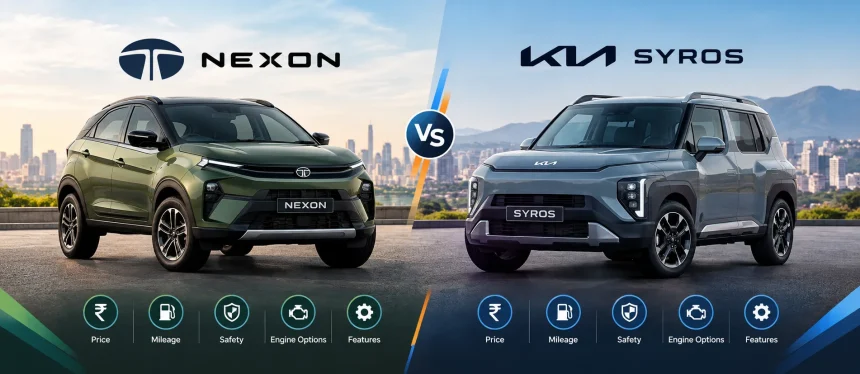
What if the compact SUV sitting in your driveway a year from now came down to just three numbers: price, mileage, and safety rating? Two of India’s most talked-about sub-4-meter SUVs, the Tata Nexon and the Kia Syros, are locked in exactly that kind of battle right now.
Both promise style, features, and value, but they take very different roads to get there. Let’s break down this Nexon vs Syros comparison properly, so you don’t have to guess.
Tata Nexon vs Kia Syros 2026: Key Specs Difference
Beyond price and mileage figures, the technical data reveals a lot about each SUV’s drivability. Take a look at the key technical comparison below.
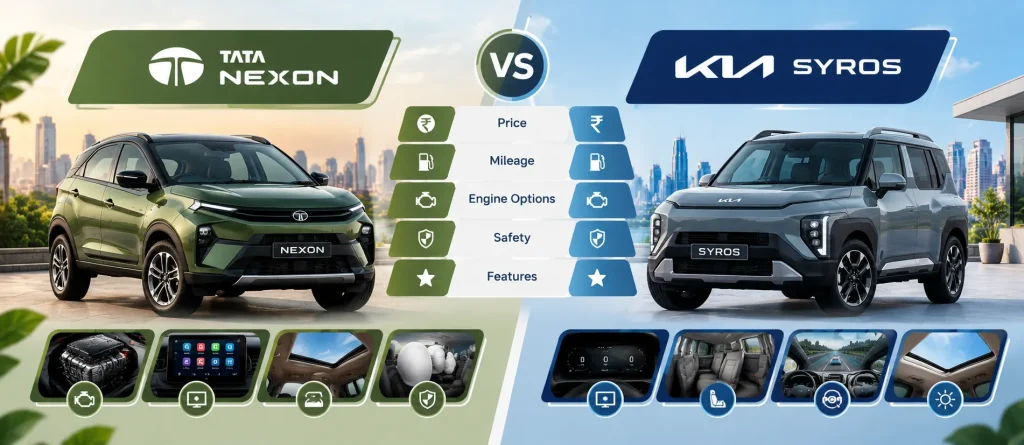
| Spec | Tata Nexon | Kia Syros |
| Petrol engine | 1.2L turbo, 118bhp (approx.) | 1.0L turbo, 120hp / 172Nm |
| Diesel engine | 1.5L turbo-diesel | 1.5L CRDi, 114bhp / 250Nm |
| Transmissions | MT, AMT, DCT, 6-speed diesel AT | MT, DCT (petrol), 6-speed TC AT (diesel) |
| Fuel options | Petrol, Diesel, CNG, EV (separate model) | Petrol, Diesel, EV (Syros EV upcoming) |
| Driving modes | Eco, City, Sport (Fearless trims) | Eco, Normal, Sport + terrain modes |
| Ground clearance | Around 209 mm | Around 190 mm |
| Boot space | 382 to 465 litres | 465 litres (approx.) |
While the Syros is fitted with a true torque converter with paddle shifters, making it smoother than the AMT in the Nexon while driving through heavy traffic, the Nexon offers a DCT transmission variant for some petrol variants to make its transmission faster shifting between gears than the former.
Nexon vs Syros Price: Who Costs What?
The first screening criterion buyers use is price, which makes the difference clear. Price-wise, the comparison between Nexon vs Syros is in favor of Tata when talking about the entry-level cars, but Kia is ahead in the upper-end spectrum.
| Model | Ex-showroom Price Range | Trims |
| Tata Nexon | ₹7.40 lakh to ₹14.52 lakh | Smart, Pure, Creative, Fearless |
| Kia Syros | ₹8.42 lakh to ₹15.82 lakh, with 18 variants on offer | HTE, HTE(O), HTK(EX), HTK+, HTX, HTX(O) |
The Kia Syros sits between the Sonet and Seltos in Kia’s SUV line-up, which explains its slightly higher starting point. Tata, meanwhile, keeps its base variant genuinely affordable while still offering a loaded flagship trim for those who want the works.
Engines and Nexon vs Syros Mileage
Both cars are available in petrol, diesel, and automatic options, but their tuning approaches differ. Mileage differences between the Nexon and Syros are minimal.
Tata Nexon powertrains:
- 1.2-liter turbo-petrol Revotron
- 1.5-liter turbo-diesel Revotron
- CNG option available
- Mileage ranges from 17.01 to 24.08 kmpl
Kia Syros powertrains:
- 1.0-litre turbo-petrol, producing 120hp and 172Nm
- 1.5-liter four-cylinder CRDi diesel, producing 114 bhp and 250Nm
- Mileage ranges from 17.65 to 20.75 kmpl
- The diesel automatic gets an ARAI-certified figure of 20.75 kmpl
On paper, Tata’s diesel-AMT variants can touch a higher claimed peak, but the Syros diesel-automatic is more consistent in real-world driving, according to several road-test reports.
Design, Space, and Dimensions
The Nexon has a classic coupe-SUV profile with creases typical of Tata, while the Syros opts for an angular, upright look inspired by the Kia EV9, according to the carmaker.
| Parameter | Tata Nexon | Kia Syros |
| Length | 3995 mm | 3995 mm |
| Width | 1804 mm | 1805 mm |
| Height | 1620 mm | 1680 mm |
| Wheelbase | 2498 mm | 2550 mm |
The increased wheelbase of the Syros means that it offers much more rear legroom, which becomes significant if you have to transport four adults. On the other hand, the Nexon offers a lower ground clearance, making it more convenient for city driving.
Features and Safety: A Closer Look
Both vehicles now offer feature sets so extensive that “compact SUV” feels like an understatement. Here’s what makes each of them stand out.
Tata Nexon highlights:
- 10.25-inch touchscreen with JBL 9-speaker system
- Panoramic sunroof, ventilated seats on top trims
- The only car in its segment offered with petrol, diesel, CNG, and EV powertrains
- First made-in-India car to secure a full 5-star Global NCAP rating, with six airbags standard
Kia Syros highlights:
- Level 2 ADAS and a panoramic sunroof across higher variants
- Scored 30.21/32 for adult occupant protection and 44.42/49 for child occupant protection in Bharat NCAP testing
- 12.3-inch touchscreen, digital key, and voice-assisted sunroof on select trims
- An electric version, the Syros EV, is expected with a claimed range of up to 526 km
Both SUVs carry a 5-star Bharat NCAP rating, so safety isn’t really a tiebreaker here — it’s more about which extra features matter to you.
Ownership and Running Costs
Running costs don’t often come up in discussions, but they shape overall happiness over time. Service costs over five years for the Syros are pegged at ₹7,214 across variants, for both diesel and petrol. Tata boasts an expansive and relatively cheaper service network on average, although costs will differ from city to city and variant to variant. In terms of resale value, Tata’s track record of over a decade in the segment will help the Nexon outperform the Seltos here.
Nexon vs Syros: Which Is Better For You?
There’s no single right answer here. It depends on what you’re optimizing for. Use this quick guide to decide:
- Choose the Nexon if: you want the lowest entry price, a CNG option, or the flexibility to switch to electric later with Tata’s EV lineup.
- Choose the Syros if: you prioritize rear-seat space, want factory-fitted ADAS, and don’t mind paying a bit more for a distinctive design.
- Choose the Nexon if: you value a wider, more established service network across smaller towns.
- Choose the Syros if: you’re drawn to Kia’s younger, tech-first brand image and premium cabin feel.
So, Nexon vs Syros: it really comes down to whether you prioritize value and flexibility (Nexon) or space and tech-forward features (Syros). Neither is objectively wrong. They’re built for slightly different buyers.
Recent Automotive Updates Worth Knowing
Staying up to date matters in this segment because both brands regularly update their trims and pricing. Recent modifications in the automobile industry: Tata launched the Camo Edition of the Nexon in August 2026, which included aesthetic changes and a new infotainment screen. Kia increased the Syros price very slightly in June 2026 and also rolled out new trims in April 2026 that reduced the starting price of diesel-automatic and turbo-petrol variants.
Final Verdict
If you’re looking for an SUV that will allow your money to go a bit farther, along with the flexibility of using different types of fuel, then the Tata Nexon is tough to beat. However, if you feel like splurging a little bit more on some additional space, ADAS, and an overall new design language, then the Syros justifies its high asking price. Drive both of these cars yourself and make the call.
FAQ
1. Which is cheaper, the Tata Nexon or the Kia Syros?
A. The Tata Nexon is cheaper at the entry level, starting around ₹7.40 lakh, while the Kia Syros starts from about ₹8.42 lakh (ex-showroom).
2. Which SUV gives better mileage, Nexon or Syros?
A. The Nexon’s diesel-AMT variants claim a higher peak figure, but the Syros diesel-automatic delivers more consistent real-world mileage around 20.75 kmpl.
3. Does the Kia Syros have ADAS features?
A. Yes, higher Syros variants come with Level 2 ADAS, a feature not currently offered on the Tata Nexon.
4. Is the Tata Nexon available in CNG or EV options?
A. Yes, the Nexon is one of the few cars in its segment offered with petrol, diesel, CNG, and a separate EV variant.
5. Which SUV has more interior space?
A. The Kia Syros has a longer wheelbase (2550 mm vs 2498 mm), giving it a slight edge in rear legroom over the Nexon.