What if your first car cost less than a flagship phone plus a weekend getaway? It’s not far-fetched. In India’s used market, ₹5 lakh goes much further than most people expect.
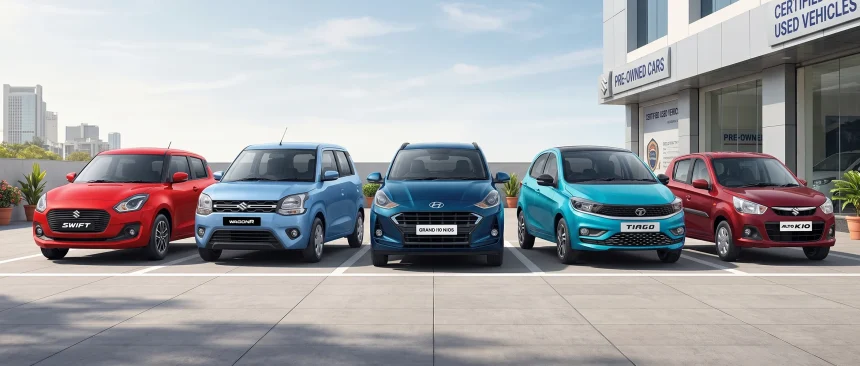
A tidy Swift, a roomy WagonR or even a near-new Tiago is well within reach. The real trick isn’t finding something cheap. It’s finding something that won’t bleed you later.
So I’ve gathered what’s actually working in 2026: realistic prices, running costs, and what each car gives back when you sell it. Grab a chai and read on. Fair warning: there are traps too, and I’ll flag them.
Why ₹5 Lakh Is the Sweet Spot Right Now?
You’re shopping in the market’s sweet spot. One buyer’s guide estimates that the ₹3-5 lakh range accounted for around 43 percent of the used car market in 2025 and is monitored as the fastest-growing segment. Take this as a rough guess, but it reflects dealership observations: first–time buyers and budget upgraders are swarming. There’s also a bit of a taxation story behind these rates. Small cars (petrol up to 1200 cc, length below 4000 mm) are now taxed at 18 percent, lower than the previous effective 29-31%.
That made new small cars cheaper, and used prices followed. Used-car platforms cut prices on small cars ahead of the change so buyers wouldn’t switch to new models. CRISIL estimates that ex-showroom prices of hatchbacks like the Alto K10, Tiago and Celerio fell by ₹40,000-70,000. What does this mean for you? The gap between new and used is narrower than it used to be. Don’t just compare used cars with each other. Check what a new Alto K10 costs too (more on that later).
Quick Snapshot: Our 5 Best Used Cars Under ₹5 Lakh in India
The prices given are estimates and will fluctuate based on city, distance covered, number of owners, and the vehicle’s condition. You can use them for negotiation.
| Car | Best Model Years | Typical Used Price | Resale Strength | Yearly Maintenance |
| Maruti Swift | 2018-2021 | ₹2.8-5.0 lakh | Excellent | ₹8,000-12,000 |
| Maruti WagonR | 2019-2022 | ₹2.6-5.0 lakh | Excellent | ₹6,000-9,000 |
| Hyundai Grand i10 Nios | 2019-2022 | ₹2.8-5.0 lakh | Good | Moderate |
| Tata Tiago | 2020-2023 | ₹2.5-5.0 lakh | Average | Maruti + 10-15% |
| Maruti Alto K10 | 2019-2023 | ₹1.5-5.0 lakh | Good | ₹5,000-8,000 |
1. Maruti Suzuki Swift: The Safe Bet
If I were asked to suggest one car name without justification,it would be the Swift. This car has a reputation as the most reliable second-hand car below 5 lakh, and the statistics back it up. The Maruti Suzuki Swift has an average depreciation rate of 27 percent in five years, which is uncommon among cars in this range.
Cost snapshot:
- Price: ₹2.8-5.0 lakh for 2018-2021 cars
- Best pick: ZXi petrol manual (2020-2021) at ₹4.0-5.0 lakh
- Upkeep: roughly ₹8,000-12,000 a year
- Service network: Maruti’s 4,000+ centers
What to check:
- Rust near the rear wheel arches, especially in coastal cities
- Clutch judder in first gear after about 40,000 km
- Damp footwell on the driver’s side
- Jerky low-speed behavior on AMT variants
Living in Delhi NCR? Pre-2018 diesel Swifts face the 10-year diesel rule, so stick with petrol.
2. Maruti Suzuki WagonR: The Practical Pick
WagonR isn’t all about style. It’s simply too practical to be anything else. Its tall-boy design ensures good headroom and space for luggage. There are 341 liters of space in the boot. This is why people keep buying WagonRs. The cost of ownership is the cheapest among all. The maintenance cost is around ₹6,000 to 9,000 per year. It delivers 22-25 km/l with its 1.2L engine.
Cost snapshot:
- Price: ₹2.6-5.0 lakh for 2019-2022 cars
- Best pick: ZXi 1.2 petrol manual (2021-2022) at ₹3.8-4.6 lakh
- Resale: top tier, in the same league as the Swift
What to check:
- Choose the 1.2L engine if you drive on highways; the 1.0L feels stretched with a full load
- Timing chain rattle on a cold start
- Water seeping through the tailgate seal (lift the boot carpet)
- Sagging door hinge on the driver’s side
The ride is on the firm side over bad roads. Take a test drive on a rough stretch before you decide.
3. Hyundai Grand i10 Nios: The Feature King
Looking for value for your money? That’s your car. Even the mid models come with an 8-inch display screen, a wireless charger for your phone, and rear AC outlets, which Maruti’s competitors usually don’t offer in the same budget range. One of the used hatchbacks below 5 lakh gives you the feel of a larger car. Spinny has 193 Grand i10 models between ₹2.33-₹5.00 lakh.
Cost snapshot:
- Price: ₹2.8-5.0 lakh for 2019-2022 Nios cars
- Best pick: Sportz petrol manual (2021-2022) at ₹4.0-4.8 lakh
- Service network: 1,300+ Hyundai centers
The catch is resale. It trails Maruti hatchbacks by roughly 5-8%. If you plan to sell within three years, that gap matters.
What to check:
- A clicking steering column on 2019-2020 cars
- AC compressor health
- Oil seepage near the timing chain cover
- AMT behavior in stop-go traffic
4. Tata Tiago: The Safety Play
Here is another value for you. The Tiago has a 4-star Global NCAP rating, and dual airbags and ABS are standard on mid versions. If you are transporting kids or parents, that makes all the difference. Tata cars depreciate faster, and it works to your advantage. A 2022-2023 XZ+ will cost ₹4.2-4.8 lakh. That means you’ll get a fresh car at a steep discount. Spinny has 124 Tiagos listed from ₹2.35-₹5.00 lakh.
Cost snapshot:
- Price: ₹2.5-5.0 lakh for 2020-2023 cars
- Best pick: XZ+ petrol manual (2021-2023) at ₹3.4-4.8 lakh
- Upkeep: about 10-15% above comparable Marutis
- Resale: trails Maruti by around 15-20%
What to check:
- Clutch judder when pulling away in first gear
- Rattles from the dashboard and door panels after about 25,000 km
- Paint quality, especially on darker colors
- Pre-2020 diesels, where parts are getting harder to find
5. Maruti Suzuki Alto K10: The Cheapest to Own
The Alto K10 won’t attract much attention at a signal, but your bank account will love it. Maintenance costs are around ₹5,000-8,000 a year, with real-world mileage above 25 km/l. For that price, you can get a newer Heartect car from 2022-2023, which is safer and more advanced than older models. The 2022-2023 VXi petrol manual costs ₹3.3-3.9 lakh.
What to check:
- Pre-2022 cars have thin panels that dent easily
- Underbody rust in humid cities
- Grinding when shifting into second gear after about 50,000 km
- Ex-driving-school cars: check the vehicle class on the RC
Here comes the truth part. The new Alto K10 is still available for under 5 lakhs. If a used car costs almost the same as a new one, it is better to buy new with a warranty.
Resale Value: What You’ll Get Back
Buying is half the story. Selling is where cars quietly reveal their true cost.
| Car | Resale Edge | Why |
| Swift | Strongest | Up to 73% retained after 5 years |
| WagonR | Very strong | Huge demand, cheap to maintain |
| Alto K10 | Good | Low entry price limits losses in rupees |
| Grand i10 Nios | Good, slightly lower | 5-8% below Maruti equivalents |
| Tiago | Weakest of the five | 15-20% below Maruti |
In simple terms, Maruti users pay a slightly higher price initially but get more value in the future. Tata users pay less initially but receive less value later. Neither is right or wrong. It depends on how long you want to own the car. If you plan to use it for seven to eight years, resale becomes less important.
The Real Cost Beyond the Sticker Price
Your budget isn’t just the number on the listing. Before you commit, keep a cushion for these:
- RC transfer and insurance transfer
- A fresh service and oil change
- New tyres or a battery if they’re tired
- Small repairs flagged during inspection
Generally speaking, I would hold back about 5-8% of the car’s price. This is simply my personal practice, not an industry standard; however, it has helped me avoid exceeding my budget more than once. Regarding GST, there is something nice for you to know. When two individuals exchange ownership of a used car, no GST is paid. Dealer GST, on the other hand, is based only on the profit margin.
Dealer, Platform or Individual?
Where you buy changes how much risk you carry. Here’s how the three routes compare.
| Source | Pros | Cons |
| Individual owner | Often the lowest price, honest history | No warranty, paperwork on you |
| Local dealer | Wide choice, bargaining room | Quality varies a lot |
| Organised platform | Inspection, paperwork, return options | Prices usually higher |
However, if you value peace of mind, consider certified pre-owned cars that cost less than 5 lakh. Spinny claims to have 2,654 such certified cars starting at around 1.36 lakh. Cars24 offers a 30-day or 999 km return policy on the cars it owns. However, certification isn’t magic. It’s an added safety measure, not a promise. Make sure you read the certification reports before buying.
Your Used Car Buying Checklist
Keep this used car buying checklist on your phone while you inspect:
Paperwork
- Original RC, matching chassis and engine numbers
- Valid insurance and PUC certificate
- Service history, ideally from an authorized center
- No loan or hypothecation flag on the RC
Body and engine
- Uneven panel gaps or mismatched paint (signs of accidents)
- Smoke from the exhaust, oil leaks, strange noises on a cold start
- Rust under the car and near the wheel arches
- Dashboard warning lights that stay on
Drive test
- Clutch bite point, gear shifts, and brake feel
- Steering pull or play
- AC cooling at idle and while moving
- Any vibration at 60-80 km/h
Final steps
- Get an independent mechanic to inspect it
- Verify the RC status online (some services charge a small fee)
- Negotiate using every flaw you found
One more thing: Never overlook the vehicle’s odometer accuracy. Check the mileage against service receipts. A 2019 model with 15,000 km is cause for concern.
Petrol, Diesel or CNG?
In such a case, petrol is the obvious option for everyone. It’s safer for city driving under ₹5 lakh. A diesel engine requires a thorough inspection of its injector and turbo components, while regulations such as the Delhi NCR diesel age limit may shorten its lifespan. CNG is an excellent choice for those who cover large distances. It is quite economical. Get your kit, cylinder certificate, and fitment papers inspected, since faulty kits can cause problems.
Honourable Mentions
A few cars narrowly missed the top five but deserve a look:
- Maruti Baleno (2017-2020): roomy, quiet and about ₹3.2-5.0 lakh. Avoid early CVT versions.
- Maruti Dzire (2017-2020): a proper sedan with a 378-liter boot and resale around 72% after five years.
- Honda Amaze (2018-2020): smooth and well-built, but parts cost 15-20% more than Maruti’s.
- Volkswagen Polo (2018-2021): the best driver’s hatchback here. It costs more to maintain and has far fewer service centers.
Keep an Eye on the Market
Used car prices do not remain stagnant. Changes in GST rates, the launch of new models, and other fuel-related policies affect prices. An expert pointed out that new-car prices are expected to rise starting next calendar year. Therefore, it’s best to stay updated on the latest auto news before making any purchase.
The Verdict
Among the options, the Swift would be my first choice because of its strong resale value and ease of maintenance. If you need ample space along with the most economical car, then WagonR is the ideal one. If you want a car with all the features, you can buy the Grand i10 Nios. If you want a secure vehicle, then Tiago would be the best option for you. The Alto K10 is the best fit for tight-budget buyers, preferably a model from 2022 or later.
FAQs
1. Which is the best used car under ₹5 lakh in India?
A. The best option would be the Maruti Swift since it has a high resale value, good servicing facilities, and good availability in all cities. The next best option is the WagonR.
2. Is a used Tata Tiago a good buy?
A. Yes, especially if safety is important. It gets 4 stars from Global NCAP and comes with standard double airbags. The downsides include poorer resale and higher maintenance costs than Maruti cars. Watch for clutch judder and interior rattling during the test drive.
3. How much should I keep aside beyond the car’s price?
A. A good rule of thumb is 5 to 8 percent for transaction costs, insurance, new servicing, and minor repairs. If you need to replace tires or the battery, budget a bit more. It’s a rule of thumb, not a set number.
4. Are certified used cars worth the extra cost?
A. Yes, that’s true, since you get an inspection, assistance in filling out forms, and also a return window, if it applies. However, read the details thoroughly. Return windows have time and distance limits. It is always a good idea to hear from your mechanic, even with certified vehicles.
5. Did the GST cut make used cars cheaper?
A. Largely yes for small cars. New hatchbacks became cheaper after the GST rate dropped to 18%, and used platforms reduced listing prices to stay competitive. The gap between new and used has narrowed, so compare both before deciding.