What if the compact SWhat if one of the most driver-focused compact SUVs in India finally fixed some of the things buyers had been complaining about? That is pretty much what Volkswagen has done with the 2026 Taigun facelift.
The updated Taigun was launched in India in April 2026, bringing a sharper look, a more modern cabin, a panoramic sunroof, and most importantly, a new 8-speed automatic gearbox with the 1.0-litre TSI engine. Volkswagen has also added a few practical upgrades, including rear disc brakes on the 1.5-litre variants and more premium equipment inside the cabin.
So, now that the facelift is already here, the bigger question is simple: Is the 2026 Volkswagen Taigun facelift worth buying?
2026 Volkswagen Taigun Facelift: Key Specifications
| Specification | Details |
| Price range (ex-showroom) | ₹10.99 lakh – ₹19.3 lakh |
| Engine options | 1.0L TSI turbo-petrol / 1.5L TSI turbo-petrol |
| Power & torque (1.0L) | Around 114-115 bhp, 178 Nm |
| Power & torque (1.5L) | Around 148-150 bhp, 250 Nm |
| Transmission (1.0L) | 6-speed MT / 8-speed AT |
| Transmission (1.5L) | 6-speed MT / 7-speed DSG |
| Claimed mileage (1.0L AT) | Up to 19.09 kmpl |
| Sunroof | Panoramic, higher variants |
| Driver’s display | 10.25-inch digital cluster |
| Infotainment | 10.1-inch touchscreen, wireless Android Auto/Apple CarPlay |
| Front seats | Powered and ventilated, higher trims |
| Boot space | 385 litres |
| Airbags | 6 |
| Braking | Front & rear disc brakes on 1.5L variants |
| ADAS | Not offered |
| Colour options | 9, including 2 new shades |
| Buyback scheme | Up to 75% assured residual value, subject to scheme terms |
What Actually Changed On The Outside?
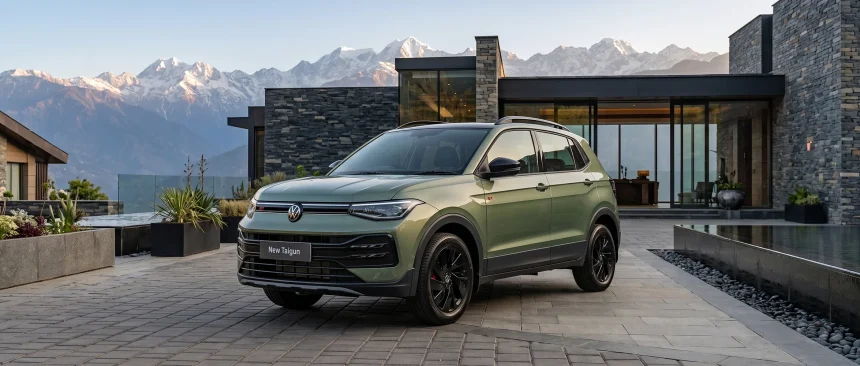
Volkswagen has taken an evolutionary approach with the 2026 Taigun facelift. The basic shape remains familiar, but the front-end changes give it a more modern appearance. The redesigned front features a slimmer grille, a full-width LED light bar, and an illuminated Volkswagen logo. The bumper has also been revised with sharper detailing and piano-black elements. Other exterior updates include:
- New 16-inch alloy wheels on lower variants and 17-inch units on higher trims
- Sequential LED taillamps with welcome and goodbye lighting animations
- GT Line variants with blacked-out badging and darker-finished wheels
- Two new exterior shades, Avocado Pearl and Steel Grey
- Nine colour options in total
The side profile has largely been carried over. That means the facelift still looks unmistakably like a Taigun, but the updated lighting and detailing make it feel fresher than before.
Is The New 8-Speed Automatic The Real Headline?
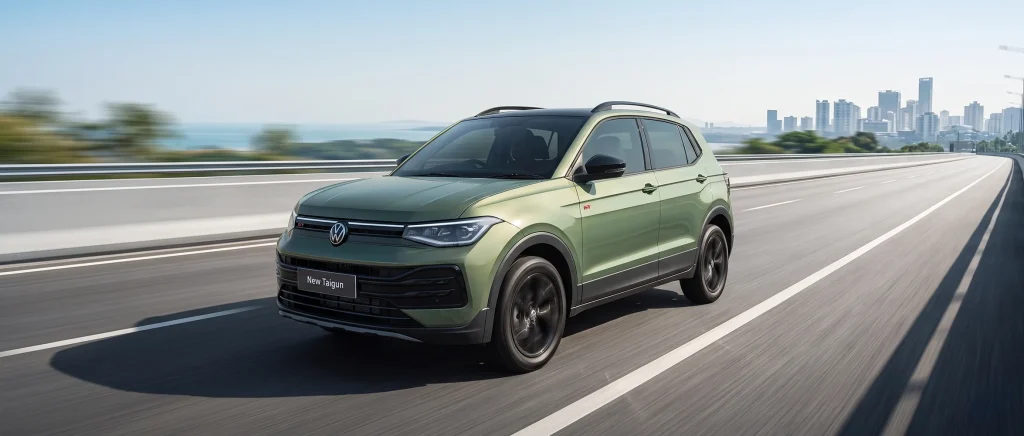
For many buyers, it probably is. The previous 1.0-liter TSI automatic used a 6-speed torque-converter gearbox. While it was perfectly usable, it wasn’t the smoothest part of the Taigun package, particularly during slow-moving city traffic. The facelift replaces it with a new 8-speed automatic gearbox. Volkswagen has also claimed better fuel efficiency with the updated setup.
| Aspect | Previous Taigun | 2026 Taigun Facelift |
| Gearbox (1.0L TSI) | 6-speed torque converter | 8-speed torque converter |
| Claimed fuel efficiency | 15.78 kmpl | Up to 19.09 kmpl |
| Highway cruising | More noticeable gear changes | More relaxed |
| 1.5L TSI gearbox | 7-speed DSG | 7-speed DSG |
Volkswagen claims around a 5.8 percent improvement in fuel efficiency for the 1.0 TSI automatic. More importantly, the additional ratios should make the SUV feel more relaxed during everyday driving and highway cruising. For buyers who liked the Taigun but weren’t completely convinced by its old automatic gearbox, this is easily one of the most important changes.
What Do You Actually Get Under The Hood?
The engine options remain familiar because Volkswagen didn’t really need to change them. Both TSI engines continue to offer a good mix of performance and everyday usability. The 1.0-litre TSI turbo-petrol produces around 114-115 bhp and 178 Nm of torque. It can be paired with either a 6-speed manual or the new 8-speed automatic.
The larger 1.5-litre TSI turbo-petrol makes around 148-150 bhp and 250 Nm. It comes with a 6-speed manual or the 7-speed DSG automatic. The 1.5-litre variants also get rear disc brakes, adding another useful upgrade to the package. Volkswagen has also equipped the facelift with a variable-geometry AC compressor, which should help with quicker and more efficient cooling, something Indian buyers will definitely appreciate during summer.
What’s New Inside The Cabin?
This is where the facelift feels considerably more substantial than the exterior changes suggest. The overall dashboard design remains familiar, but Volkswagen has added more technology and convenience features. The Taigun facelift features include:
- 10.25-inch fully digital driver’s display
- 10.1-inch touchscreen infotainment system
- Updated infotainment interface with AI-based voice assistant
- Panoramic sunroof on higher variants
- Powered and ventilated front seats
- Wireless Apple CarPlay and Android Auto
- Wireless smartphone charging
- Dual-tone cabin theme with multiple upholstery combinations
- Rear AC vents
- Type-C charging ports for rear passengers
The luggage capacity remains at 385 litres, so there is no major change in practicality. It is also worth noting that the Taigun doesn’t get some of the features available on the facelifted Skoda Kushaq, such as a rear-seat massage function and a 360-degree camera.
Does It Get Safer Too?
The 2026 Taigun facelift continues with a strong set of standard safety features, although Volkswagen hasn’t gone all-out with advanced driver assistance technology. The SUV gets six airbags, ABS, EBD, electronic stability control, traction control, hill-hold assist, electronic differential lock and ISOFIX child-seat mounts.
Front parking sensors are now standard from the entry-level variant, which is a useful addition for everyday city driving. However, there is no Level 2 ADAS or 360-degree camera on this facelift. So, while the basic safety package is comprehensive, buyers specifically looking for the latest driver-assistance features may find the Creta and Seltos more appealing.
What’s The VW Taigun Facelift Price In India?
The VW Taigun facelift price in India starts at around ₹10.99 lakh ex-showroom for the entry-level Comfortline manual and goes up to approximately ₹19.3 lakh for the higher GT Line variants.
Here is a look at the main variants:
| Variant | Transmission | Approx. Price (ex-showroom) |
| Comfortline | 6-speed MT | ₹10.99 lakh |
| Highline | 6-speed MT | ₹12.69 lakh |
| Highline | 8-speed AT | ₹13.79 lakh |
| Highline Plus | 6-speed MT | ₹14.29 lakh |
| Highline Plus | 8-speed AT | ₹15.40 lakh |
| GT Line (1.0 TSI) | 6-speed MT | ₹14.59 lakh |
| GT Line (1.0 TSI) | 8-speed AT | ₹15.74 lakh |
Volkswagen has also introduced an assured buyback programme offering up to 75 percent residual value after up to three years or 30,000 km, subject to the applicable programme terms. For buyers worried about the resale value of a Volkswagen, this can make the ownership proposition more attractive.
Taigun vs Creta vs Seltos: Does It Still Compete?
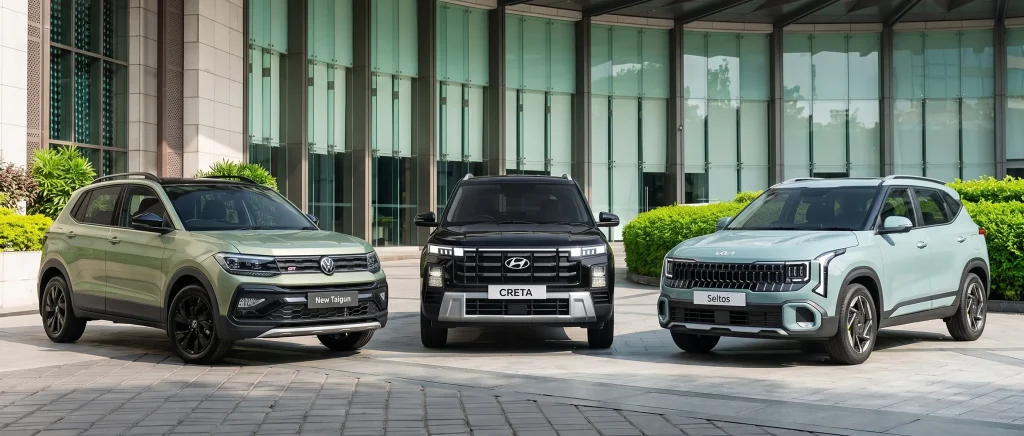
The Taigun vs Creta vs Seltos debate hasn’t become any easier after the facelift. The Taigun continues to focus heavily on driving dynamics, engine performance and a solid driving experience. The Hyundai Creta and Kia Seltos, meanwhile, put a bigger emphasis on features, technology and a wider choice of powertrain options.
| Factor | Taigun Facelift | Hyundai Creta | Kia Seltos |
| Engine feel | Turbo-petrol, driver-focused | Refined and versatile | Sporty, turbo option available |
| Gearbox options | 8-speed AT and 7-speed DSG | Multiple automatic options | Multiple automatic options |
| ADAS | Not offered | Available on higher trims | Available on higher trims |
| Cabin tech | Significantly updated | Feature-rich | Feature-rich |
| Driving dynamics | Sharp and planted | Comfortable and easy-going | Balanced |
The Creta and Seltos have an advantage if your priority is a long list of features and ADAS. But if driving enjoyment is high on your list, the Taigun remains one of the more appealing choices in the segment. And now that the 1.0 TSI gets an 8-speed automatic, one of the biggest question marks around the Taigun has been addressed.
Should You Buy The 2026 Volkswagen Taigun Facelift?
Now that the facelift has already launched, there is no reason to think about whether you should wait for it. The real question is whether it makes sense to buy one. For someone who wants a compact SUV with strong driving dynamics, punchy turbo-petrol engines and a more premium cabin, the updated Taigun makes a convincing case.
The new 8-speed automatic is arguably the biggest improvement, while the panoramic sunroof, digital driver’s display, ventilated seats and updated infotainment system make the cabin feel more competitive. The biggest missing pieces are Level 2 ADAS and a 360-degree camera. If those features are must-haves, the Creta and Seltos deserve a closer look. But if you care more about how a car drives than how long its features list is, the 2026 Taigun facelift remains one of the more interesting SUVs in its segment.
FAQ
1. What is the starting price of the 2026 Volkswagen Taigun facelift?
A. It starts at approximately ₹10.99-11 lakh (ex-showroom) for the base Comfortline manual variant and goes up to around ₹19.3 lakh for the top GT Line automatic trim.
2. Does the Taigun facelift get a panoramic sunroof?
A. Yes, the panoramic sunroof is offered on the higher-spec variants, a segment feature the outgoing model was previously missing.
3. What’s new about the automatic gearbox?
A. The 1.0-liter TSI engine now pairs with a new 8-speed torque converter automatic, replacing the older 6-speed unit, along with claimed improvements in fuel efficiency and refinement.
4. Does the Taigun facelift offer Level 2 ADAS?
A. No, this update doesn’t include Level 2 ADAS or a 360-degree camera. Volkswagen has reportedly reserved these for the next full-generation model.
5. How does the Taigun facelift compare to the Creta and Seltos?
A. The Taigun leans on driving dynamics, build quality, and its new gearbox, while the Creta and Seltos generally offer more features and available ADAS. The right pick depends on whether you prioritize driving feel or feature count.