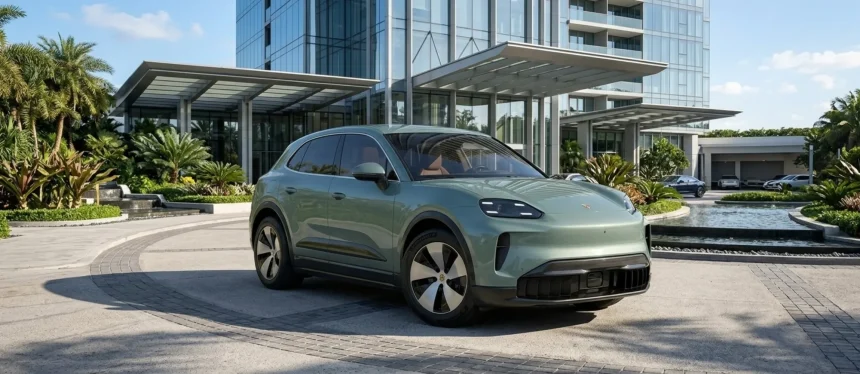
What if the Porsche you park outside your Mumbai high-rise never needed a drop of petrol, yet still pinned you to the seat like a sports car? That’s the question Porsche answered on 30 September 2026, when the all-electric Cayenne officially arrived in India.
Priced from ₹1.77 crore, it’s the biggest, most practical electric Porsche you can buy here. But is it simply a Cayenne with a battery, or something genuinely new?
We’ve gathered the confirmed numbers from verified sources, sorted fact from hype, and put everything into one honest buying guide. Grab a chai, because there’s a lot to cover.
Porsche Cayenne EV India: Quick Snapshot
Here’s the short version before we go deeper.
| Detail | Cayenne Electric | Cayenne Turbo Electric |
| Ex-showroom price | ₹1,77,27,000 | ₹2,27,51,000 |
| Battery | 113 kWh | 113 kWh |
| Drive | Dual motor, AWD | Dual motor, AWD |
| Power | 408 hp (442 hp with Launch Control) | 857 hp (1,156 hp with Launch Control) |
| Torque | 750 Nm (835 Nm) | 1,360 Nm (1,500 Nm) |
| 0-100 km/h | 4.8 sec | 2.5 sec |
| Claimed range | Up to 642 km | Lower than base (see below) |
| DC charging | Up to 390-400 kW | Up to 390-400 kW |
Prices are ex-showroom and before options. Some outlets round the Turbo to ₹2.27 crore and others to ₹2.28 crore. Both are the same car.
Why This Launch Matters for Porsche EV India?
The Cayenne Electric is the third all-electric Porsche on sale here, after the Taycan and the Macan Electric. That makes it a big moment for Porsche EV India. It’s also the largest of the three, and in Turbo form, the most powerful.
Porsche hasn’t abandoned petrol, either. The company has said petrol Cayenne variants will stay on sale well into the next decade. So buyers get a real choice instead of a forced switch. Ashutosh Dixit, Head of Porsche India, described the launch as the start of a new era for the Cayenne, blending Porsche performance with electric mobility.
Price in India: What You’ll Actually Pay
The ₹1.77 crore number is the headline, but it isn’t what leaves your bank account.
- Cayenne Electric: ₹1.77 crore ex-showroom
- Cayenne Turbo Electric: ₹2.27-2.28 crore ex-showroom
- Petrol Cayenne (for reference): starts around ₹1.38 crore, so the electric costs roughly ₹39 lakh more
Insurance, registration, and any state-level charges come on top. Road tax rules for EVs differ across states, so check with your local dealer. And this is Porsche, so expect the options list to add a meaningful chunk to the final bill. Porsche India had revealed pricing earlier, and bookings opened in late 2025. September’s event was mainly the formal debut and the start of deliveries.
Design and Dimensions
If you were hoping for a radical redesign, you’ll be a little disappointed. And that’s probably the right call. The Cayenne still looks like a Cayenne, with the sloping roofline intact. The front is cleaner than the petrol model’s, with a wide air dam and vertical intakes framed by subtle black cladding. It borrows design language from the smaller Macan Electric.
The numbers:
| Dimension | Measurement |
| Length | 4,985 mm |
| Width | 1,980 mm |
| Height | 1,674 mm |
| Wheelbase | 3,023 mm |
| Seating | 5 |
It’s 55 mm longer than the petrol Cayenne, and the wheelbase grows by almost 13 cm. Most of that extra space goes straight to rear passengers.
Performance: Two Very Different Personalities
Both variants use dual electric motors and all-wheel drive. They sit on the Volkswagen Group’s 800V Premium Platform Electric architecture, the same family of tech behind the Macan Electric.
The standard Cayenne Electric makes 408 hp and 750 Nm. Engage Launch Control and that rises to 442 hp and 835 Nm. The 0-100 km/h sprint takes 4.8 seconds. That’s brisk for a car this size, and honestly more than most owners will ever use.
The Turbo Electric is a different animal. It makes 857 hp normally and a frankly absurd 1,156 hp with Launch Control. Torque climbs to 1,500 Nm, and 0-100 km/h takes 2.5 seconds.
A small note on units: you’ll see 1,154 bhp in some reports and 1,156 PS in others. It’s the same figure, just converted differently.
Battery, Cayenne Electric Range and Charging
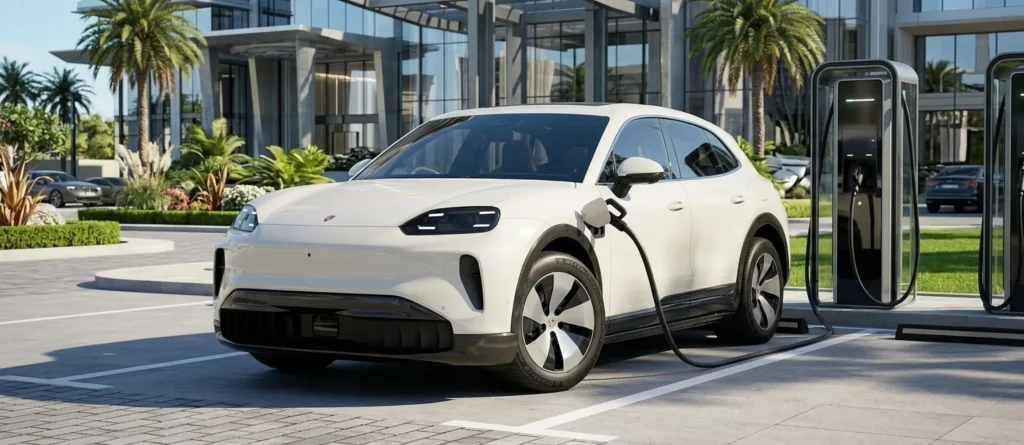
Both variants share a 113 kWh battery. The headline Cayenne Electric range is a claimed 642 km for the standard model. Treat that as a best-case lab figure. Real-world numbers depend on speed, temperature, load, and how heavy your right foot gets, and an 800-hp-plus SUV rewards heavy feet.
Charging is where this car shows off.
- DC fast charging: up to 390 kW, and up to 400 kW in certain conditions
- 10 to 80 per cent: around 16 minutes under ideal conditions
- 10 minutes of charging: adds roughly 290-325 km depending on variant
- AC charging: 11 kW as standard
- Regenerative braking: up to 600 kW
One report mentions 26 minutes for 10-80 per cent on a 400V charger. That’s the slower scenario, and it’s useful to know about because many chargers aren’t 800V.
The Wireless Charging Bit
This is a genuine first. The Cayenne Electric is the first Porsche, and the first car in India, to offer optional inductive charging. You park over a floor plate and it charges at up to 11 kW with no cable. Is it essential? No. Is it lovely if you own a garage and hate plugging in? Absolutely.
Interior and Features
Step inside and you’ll find a big curved display setup, four-zone climate control, and ventilated front seats. An augmented-reality head-up display is optional, and it’s genuinely handy for navigation. Standard equipment reported at launch includes:
- 10-speaker sound system
- 8-way powered and heated front seats
- Driver’s seat memory function
- Panoramic sunroof
- Four-zone climate control with cabin air purifier
- Powered boot lid
- Powered rear sunshades
- 360-degree camera
- ADAS features
Rear seats are electrically adjustable, which helps if you’re chauffeur-driven part of the week. Plenty of Indian buyers are in this segment.
Boot Space and Practicality
This is where an electric SUV can either shine or embarrass itself. The Cayenne shines.
| Storage | Capacity |
| Rear boot | Up to 781 litres |
| Front boot (frunk) | Around 90 litres |
| Boot, rear seats folded | Up to 1,588 litres |
That’s a proper family-and-luggage setup. Golf bags, strollers, and a weekend’s worth of bags all fit without drama.
Suspension and Driving Dynamics
Porsche hasn’t just dropped a battery into the old car. The chassis package is rich:
- Adaptive air suspension with PASM
- Rear-axle steering
- Porsche Torque Vectoring
- Porsche Dynamic Chassis Control
The Turbo adds a PTV Plus limited-slip rear differential, upgraded performance brakes, and active aerodynamic parts. It also gets Porsche Electric Sport Sound, which gives the car a synthesized voice. Whether you love or loathe artificial sound is personal, but it’s good to have the option. Rear-wheel steering matters more than you’d think. It makes a 5-meter SUV feel smaller in tight Indian parking lots and at U-turns.
Cayenne Electric vs Macan Electric
This is the question most buyers will actually be asking. The Cayenne Electric vs Macan Electric debate comes down to size, space, and budget.
| Factor | Cayenne Electric | Macan Electric |
| Starting price (approx.) | ₹1.77 crore | Around ₹1.22 crore |
| Top-end price (approx.) | ₹2.27 crore | Around ₹1.73 crore |
| Size | Larger, 5-seater, 3,023 mm wheelbase | Smaller, compact SUV |
| Charging tech | 800V, up to 400 kW | 800V |
| Best for | Families, chauffeur use, long trips | City use, smaller households |
The Macan price band comes from launch-time comparisons, so confirm current figures with your dealer.
The honest take: if you rarely carry more than two people, the Macan saves you serious money. If rear-seat comfort and luggage matter, the Cayenne earns its premium.
Cayenne Electric vs Its Rivals
The luxury electric SUV India space is getting crowded. Autocar India compares the Cayenne against the BMW iX, Audi Q8 e-tron, Mercedes-Benz EQS SUV, and Lotus Eletre. Other reports also name the Mercedes-Maybach EQS SUV and the upcoming Range Rover Electric.
On charging, the Cayenne leads. It peaks at 400 kW, versus roughly 350 kW for the Eletre, 200 kW for Mercedes, 195 kW for BMW, and 175 kW for Audi. In 10-80 per cent terms, the Cayenne needs about 16 minutes, the Eletre around 20, and the others roughly 35.
The Mercedes EQS SUV is the only seven-seater in that group, so it wins if you need a third row.
The Charging Reality Check
Here’s the part brochures skip. India’s public charging network can’t yet use a 400 kW-capable car to its full potential. Very few chargers deliver anywhere near those speeds.
So what does that mean for you?
- Home charging will do most of the work. Install a good wallbox.
- Highway trips need planning around the fastest available chargers.
- That 16-minute figure needs a compatible high-power charger, which is rare today.
The car is future-ready. The infrastructure is catching up. If you live in a city with decent charging and mostly drive locally, you’ll barely notice the gap.
Which Variant Should You Buy?
Choose the Cayenne Electric (₹1.77 crore) if:
- You want the practical, everyday option
- 408-442 hp already feels like plenty
- You’d rather keep ₹50 lakh for options, insurance, or a second car
Choose the Cayenne Turbo Electric (₹2.27 crore) if:
- You want bragging rights and the 2.5-second sprint
- You enjoy track days or spirited drives
- Money isn’t the deciding factor
For most Indian owners, I’d lean towards the standard Cayenne Electric. Few roads here let you use even a fraction of the Turbo’s potential, and the range advantage on the base car is real.
Who Should Skip It?
Not every buyer should rush in. Think twice if:
- You travel long distances often and rely on public chargers
- You have no dedicated parking for a home charger
- You need seven seats
- You want a quieter, lower-profile purchase
There’s no shame in a petrol Cayenne, either. It’s cheaper and still on sale.
What Does This Mean for the Car Market News?
The launch is more than a single product story. In the wider car market news cycle, it signals that ultra-luxury brands see Indian EV demand as serious enough to bring their flagship SUVs here, not just compact models.
It also shows how premium buyers are shifting. People spending ₹1.5 crore and above increasingly expect an electric option from the badge they already trust. Expect rivals to respond, with more launches and sharper pricing in the coming months.
Final Verdict
The Porsche Cayenne Electric isn’t cheap, and it never will be. But it’s a convincing package: strong range, class-leading charging speeds, a big boot, and the kind of driving feel you’d expect from the badge. The base car at ₹1.77 crore is the smarter pick. The Turbo is a statement. Either way, take a long test drive before committing, and check the options list carefully, because that’s where budgets quietly expand.
FAQs
1. What is the price of the Porsche Cayenne Electric in India?
A. The Cayenne Electric starts at ₹1,77,27,000 ex-showroom. The Cayenne Turbo Electric costs ₹2,27,51,000 ex-showroom. On-road prices will be higher after insurance, registration, and options.
2. What is the claimed range of the Cayenne Electric?
A. Porsche claims up to 642 km for the standard Cayenne Electric on its 113 kWh battery. Real-world range will be lower and will vary with driving style, speed, and conditions.
3. How fast does the Cayenne Electric charge?
A. It supports DC charging up to 390-400 kW. Under ideal conditions, 10-80 percent takes about 16 minutes. Charging on a slower 400V charger can take around 26 minutes.
4. When did deliveries begin in India?
A. Deliveries began on 30 September 2026, the same day as the Mumbai launch event. Bookings and pricing had already been announced in late 2025.
5. Is the Cayenne Electric better than the Macan Electric?
A. It depends on your needs. The Cayenne is larger, roomier, and costs more. The Macan is more affordable and suits city-focused buyers who don’t need as much rear-seat space or luggage capacity.