
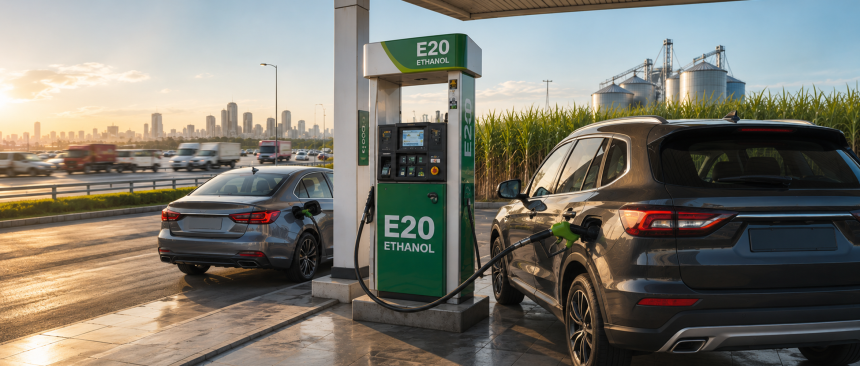
Ever wondered what happens to a country’s fuel policy once it hits its own target? India just crossed a big one. Every petrol pump now sells E20, the 20 percent ethanol blend the government had been working toward for years.
But instead of slowing down, the ethanol story is picking up pace in a completely different direction. Now there’s talk of ethanol ATMs for your kitchen, ethanol-powered flights, and even exporting the stuff to neighboring countries. Here’s what’s actually going on.
What Are Ethanol ATMs and How Would They Work?
The idea sounds unusual at first, but it’s really just an extension of something India already does well at scale. Here’s a simple breakdown of what an ethanol ATM actually is and why the government is exploring it now.
How the Pilot Rollout Would Work?
The concept works a lot like refilling an LPG cylinder, except it happens through a dispensing kiosk set up at a fuel retail outlet rather than through a delivery truck reaching your doorstep. Consumers would bring or buy a specially designed canister, fill it with ethanol at the kiosk, and use it with a compatible stove built to run on ethanol as cooking fuel. Oil marketing companies are expected to begin with small pilot installations at select outlets before deciding whether the model is ready to scale up nationally.
However, success will depend on a few practical considerations rather than the concept alone. The willingness of consumers to accept a fuel their families have never used to cook with before, safe handling of the ethanol in homes, and the availability of a stove that can accommodate the use of such fuel will determine whether it can make it out of its pilot phase. Observers from the industry have noted that this is an entirely new category of fuels in retail.
Why Does Surplus Ethanol Needs New Uses?
The bigger motivation here is surplus supply that’s been building up for a while now, faster than the country’s actual consumption needs. India’s ethanol production capacity has crossed 20 billion liters a year and is headed toward nearly 24 billion liters soon, while the E20 program itself only needs around 11 billion liters annually to keep every pump across the country properly supplied with blended fuel. That gap alone represents a sizeable chunk of unused capacity sitting with producers right now.
Industries like liquor, pharmaceuticals, and chemicals absorb another 3 to 3.5 billion liters between them every year, but even after accounting for that existing demand, several billion liters of production capacity remain underutilized annually across the country’s distilleries. Ethanol ATMs are essentially one practical way to put that surplus to productive use, while also giving sugar mills and grain-based distilleries a fresh revenue stream beyond just supplying the petrol blending program they were originally set up to serve for decades.
India’s E20 Journey So Far
What is India’s ethanol blending target for 2026? India completed its ethanol blending target of 20 percent well ahead of its original 2030 deadline, with every petrol pump nationwide dispensing E20 fuel since April 2026 as the country’s default petrol grade. Before diving into what comes next, it helps to understand how India actually got here. The blending push wasn’t a sudden decision. It’s been building steadily for over a decade now.
From E10 to Nationwide E20
The addition of ethanol in Indian petrol began at about 1.5 percent almost a decade back, which gradually increased as sugar factories and grain-based distillery plants gained production capacity in states like Uttar Pradesh, Bihar, and Maharashtra over successive years. The government met the 10 percent mark of blending in May 2022, well ahead of schedule, and worked further towards reaching the E20 blend, ,which, according to industry experts, was not expected to come true for several years in the future.
This was no coincidental achievement either. Higher ethanol production capacity in India, infrastructure development for distilleries in several states, and consistent government support helped the government bring forward its E20 target years before the original schedule. In April 2026, all the petrol pumps of the country were selling the fuel blend of E20 as the standard grade.
The Economic and Environmental Payoff
Based on data presented by the government, through this blending process, the country has been able to save nearly two lakh crore rupees in foreign exchange since 2014-15, which the government regularly points out as clear evidence that it has made the program worthwhile again and again over the years. These savings come straight out of the reduction in the amount of crude oil India requires importing each year to run its huge fleet of vehicles smoothly.

The push wasn’t only about saving money on imports either. Officials say the program has also cut crude oil imports by several crore tonnes and reduced carbon emissions substantially over the years, while generating additional farmer income running into lakhs of crores across sugar and grain-growing states all over India. That combination of energy security, environmental benefit, and rural income growth is exactly why the government kept accelerating the E20 timeline instead of sticking to its original, slower 2030 roadmap for a full rollout.
What This Means for Flex-Fuel and Regular Petrol Vehicles?
Not every car on Indian roads handles ethanol the same way, and this is where things get a little more relevant to actual car owners. Here’s the difference between what’s on the road today and what’s still genuinely experimental.
True Flex-Fuel Cars Are Still Rare
If you see a “flex fuel” badge on a car sold in India today, what you’re actually getting is an E20-compatible petrol vehicle, not a genuine flex-fuel vehicle capable of running on much higher ethanol blends without any trouble at all. True flex-fuel vehicles, or FFVs, are designed to run on anything from plain petrol up to E85, an 85 percent ethanol blend, without needing any hardware changes to the fuel system, seals, or engine calibration whatsoever.
Prototypes like the Toyota Hyryder Flex and a Maruti WagonR Flex version have already been shown publicly, giving a small glimpse of what flex-fuel vehicles India 2026 buyers might eventually get to choose from at their local dealerships. Neither is available for retail purchase yet, though, and manufacturers are still gathering real-world data before committing to a full commercial launch, since converting an existing petrol car to flex-fuel isn’t a simple or particularly economical process either way.
Where E85 Pumps Actually Exist?
E85 fuel is only sold through a few hundred pilot pumps located in the sugarcane-growing states of Maharashtra, Uttar Pradesh, Karnataka, and Gujarat, in contrast to the around 88,000 regular petrol stations that are spread throughout India. The selection of such sites was based on their proximity to ethanol-producing centers, making logistics easier to control during the current pilot implementation process of the broader national rollout plan.
The nationwide implementation of E85 is not included in the official road map, and it is not planned to become an all-India fuel any time soon, remaining a regional fuel. E20 blend will remain the type of the fuel for the vast majority of Indian motorists for quite some time to come, no matter what the evolution of the broader conversation about flex fuel may be in the future.
Does E20 Affect Mileage and Engine Health?
Does E20 petrol affect car mileage? Yes, to some extent. Ethanol carries less energy than petrol by volume, so controlled tests by India’s Automotive Research Association show a fuel consumption drop of roughly 2 to 6 percent, with older, non-compliant vehicles typically seeing a bigger dip than newer ones. This is probably the question most car owners actually care about, so let’s get into the specifics of what the testing and real-world feedback actually show.
What the Official Testing Shows?
Vehicles manufactured from April 2023 onward are built and certified to run on E20 without any modifications needed at all, since manufacturers have since redesigned fuel lines, seals, and engine calibration specifically to handle the ethanol-blended petrol mileage impact right from the factory floor. Industry body SIAM has maintained that E20 is safe to use across the board, including in older vehicles, even though it does bring some drop in fuel efficiency compared to running on plain petrol alone.
Owners of pre-2023 vehicles, however, have reported a noticeably wider range of mileage complaints in various consumer surveys conducted since the transition began rolling out nationwide across different states and regions. Some of these surveys suggest real-world mileage loss for older vehicles can run higher than the controlled lab figures typically quoted by officials, which has kept the mileage debate fairly active among everyday drivers even as manufacturers continue insisting the fuel itself remains completely safe.
The Engine Wear Concern for Older Vehicles
Apart from that, there is the question of engine condition, which is an issue that needs some consideration. Ethanol reacts differently than pure gasoline in the fuel system, and for vehicles that were not initially designed to accommodate it, there may be accelerated wear of rubber and plastic parts such as fuel hoses, seals, gaskets, and the like over time and during daily operation. That is a genuine mechanical problem that should not be confused with a mere mileage issue.
That is one of the reasons why car manufacturers emphasize the importance of looking through the car manual or having the local dealership check the compatibility of the particular car or two-wheeler with the new fuel blend if it was purchased prior to the April 2023 deadline. Such an examination in the service center should be enough to make sure that nothing needs special attention due to the new fuel standard used across the country.
What’s Next: SAF, Exports, Flex-Fuel Push?
E20 was never meant to be the finish line. It was always framed as one stop along a longer biofuel roadmap. Here’s a quick look at where India’s ethanol ambitions are headed next.
Ethanol in Aviation Fuel
Aviation is one of the more surprising directions this whole ethanol story is taking now, moving well beyond just road transport and daily commuting. The government has mandated at least 1 percent sustainable aviation fuel, or SAF, blending on international flights by 2027, and companies are now accelerating alcohol-to-jet technology to convert ethanol directly into usable jet fuel for commercial aircraft operating out of major Indian airports.
NTPC Green Energy and GPS Renewables are jointly setting up what’s expected to be India’s first ethanol-to-jet plant near Visakhapatnam, a genuinely significant step forward for a fuel that started out purely as a small petrol additive just over a decade ago. If this scales successfully over the next few years, it could open up an entirely new demand channel for India’s ethanol producers well beyond what road transport alone ever needed from them before.
Exports and the Road Ahead for FFVs
Exports are also firmly on the table now that domestic supply has clearly outpaced demand within the country itself over the past couple of years or so. Neighboring countries like Nepal, Bangladesh, and Indonesia have their own blending targets in place but lack the domestic ethanol production capacity to actually hit them, making India a fairly natural supplier for surplus volumes that would otherwise sit unused in storage tanks across producing states.
Combine that with the ethanol ATM plans for cooking fuel and the slow, steady push toward flex-fuel vehicles on Indian roads, and it becomes clear that ethanol is shifting from being a simple petrol additive to becoming a genuine multi-sector energy resource for the country. Where this all lands over the next few years will likely depend heavily on how well the cooking fuel pilots and flex-fuel prototypes actually perform once tested under real, everyday conditions nationwide.
FAQs
1. What is an ethanol ATM?
A. It’s a proposed dispensing kiosk set up at existing fuel outlets where households can refill ethanol canisters for cooking use, working much like how LPG cylinders or petrol are currently distributed to consumers across the country.
2. What is E20 petrol and is it available across India?
A. E20 is petrol blended with 20 percent ethanol, and it has been available at every petrol pump nationwide since April 2026, replacing the earlier E10 blend as the country’s new default petrol grade for all vehicles.
3. Does E20 fuel reduce car mileage?
A. Yes, controlled testing shows a fuel efficiency drop of roughly 2 to 6 percent, mainly because ethanol carries less energy per liter than pure petrol, with older vehicles typically experiencing a somewhat larger dip than newer, E20-optimized ones.
4. Is my car compatible with E20 petrol?
A. Most vehicles manufactured from April 2023 onward are built and certified to run on E20 without issues. If your car is older than that, it’s worth checking your owner’s manual or asking your dealer to confirm compatibility.
5. What is a flex-fuel vehicle?
A. A flex-fuel vehicle, or FFV, can run on any blend of petrol and ethanol, from plain petrol up to E85, without needing hardware changes. True FFVs aren’t yet sold to the public in India, though prototypes have been shown.