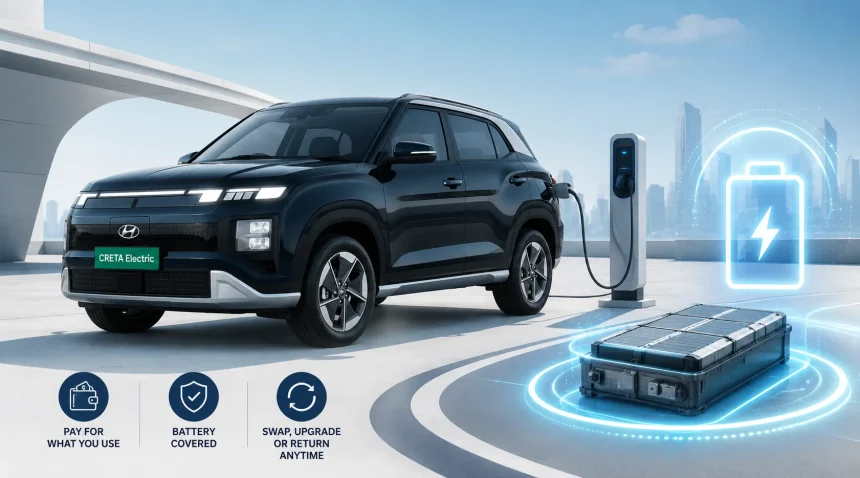
What if you could buy an electric SUV for almost the same price as its petrol version? That question is exactly what Hyundai is trying to answer with Creta Electric BaaS.
This is a new ownership model in which people can drive off the showroom floor for ₹10.99 lakh, instead of paying a hefty ₹18 lakh upfront. The money isn’t saved; it’s merely moved to another invoice.
It sounds almost too simple. But like most financial decisions dressed up as convenience, there’s more to unpack once you look past the headline number.
What Is Battery-as-a-Service?
Battery as a Service India is a straightforward idea once you strip away the jargon. In a normal EV purchase, the price you pay covers two things bundled together: the car itself and the battery pack sitting under the floor. Since the battery is typically the most expensive single part of an electric vehicle, often 30 to 40 percent of the total cost, that bundling is what makes Electric Vehicles feel so pricey compared to petrol cars at the time of purchase. BaaS unbundles the two. You buy the vehicle at a reduced price, and the battery is offered through a usage-linked rental or EMI plan, a bit like buying a phone separately from its data plan.
Who Else Offers It in India?
Hyundai isn’t the first to try this model here. MG Motor introduced it with the Windsor EV, and Maruti Suzuki followed with the e-Vitara earlier in 2026. This growing shift toward EV battery subscription models in India is starting to reshape how electric SUVs get priced and compared against each other.
| Brand & Model | BaaS Starting Price | Battery Rental |
| Hyundai Creta Electric | ₹10.99 lakh | ₹3.90/km |
| Maruti Suzuki e-Vitara | ₹10.99 lakh | ₹3.99/km |
| MG Windsor EV | Similar bracket | Per-km rental |
How does the Hyundai Creta Electric Battery-as-a-Service Plan work?
In this model, the Hyundai Creta Electric prices for BaaS begin at ₹10.99 lakh after the exclusion, which is about ₹7.04 lakh lower than the regular price of ₹18.03 lakh for the basic 42kWh Executive variant. This is the one that is making news headlines, and for good reason. However, the battery isn’t provided free of charge simply because it isn’t included in the price tag. It is purchased at a per-kilometer rate of ₹3.90/km for the 42kWh variant. Hyundai provides financing for about 90% of the battery’s cost for eight years, which means the interest rate would be around 8.75%.
What You Still Get With BaaS?
Choosing BaaS doesn’t mean missing out on the car’s core features. The Creta Electric continues to offer:
- Two battery options: 42kWh and 51.4kWh, with up to 510 km of ARAI-certified range on the larger pack
- DC fast charging from 10% to 80% in about 39 minutes
- A standard integrated side foot step for easier entry, given the raised floor
- An upgraded 7.4 kW AC wall box charger on HC variants, replacing the older 11kW unit
- The usual 8-year or 160,000 km battery warranty, whichever comes first, regardless of ownership model
Upfront Price vs Subscription Cost
A lower entry price doesn’t automatically translate into a cheaper car over time. If you buy the Creta Electric outright, you pay ₹18.03 lakh upfront, and from then on, your running costs are essentially just electricity. If you go with BaaS, your upfront cost drops to ₹10.99 lakh, but every kilometer adds ₹3.90 to your battery bill, on top of the charging cost you’re already paying.
A Quick Running-Cost Snapshot
| Monthly Distance | Battery Rental Cost (approx.) |
| 500 km | ₹1,950 |
| 1,000 km | ₹3,900 |
| 2,000 km | ₹7,800 |
Stretch that across eight years, the typical financing tenure for the battery, and high-mileage owners could end up paying more in total than they would have by simply buying the car outright. Low-mileage owners, on the other hand, might come out genuinely ahead.
Who Should Choose BaaS vs Outright Purchase?
Creta Electric BaaS is neither better nor worse. It all depends on who asks. For those of you who have just decided to own an electric vehicle but are held back by the ₹18 lakh price point, the BaaS variant makes this SUV a contender among petrol SUVs with good specifications. This is feasible only for those of you who drive moderately, say 1,000-1,200 km per month.
When Does an Outright Purchase Make More Sense?
High-mileage drivers, business users, or anyone covering long daily distances will likely find the per-kilometer charge eating into whatever they saved at purchase. There’s also a resale angle: a car with the battery bundled in tends to have a more predictable resale value, since a buyer knows exactly what they’re getting. Under BaaS, a second-hand buyer would need to take over the battery financing or negotiate around it, which complicates the sale.
Long-Term Cost Comparison
Looking at the bigger picture, however, the decision becomes one between current cash flow and total cost in eight years’ time. For those who prioritize flexibility, BaaS shifts a portion of the car’s initial cost into the operating cost, which works well for people who want to keep their options open or simply do not know how much they will use the EV. For an outright purchase, you need to know your driving habits because this method lets you avoid the hidden cost per kilometer during long-distance driving.
Conclusion
However, the Hyundai Creta Electric’s BaaS model is no gimmick, but it definitely doesn’t qualify as a discount either. It helps cut down the entry barrier for customers who have priced themselves out of buying an electric vehicle, putting the actual cost down the road in the form of kilometers driven at a fixed rate per kilometer. This works to the advantage of people who don’t drive too many kilometers every month. But for those who do rack up large numbers of kilometers per month, it would make sense to purchase it outright.
FAQs
1. What is Battery as a Service for electric cars?
A. It’s an ownership model where the EV’s battery cost is separated from the vehicle’s price. You buy the car at a lower upfront cost and pay for the battery separately, usually through a per-kilometer rental tied to actual usage.
2. Is Creta Electric cheaper with BaaS?
A. It’s cheaper to buy, since the starting price drops from ₹18.03 lakh to ₹10.99 lakh. Whether it’s cheaper overall depends on how much you drive, since the ₹3.90/km battery rental can add up for high-mileage owners.
3. How much do you pay monthly for the Creta Electric battery?
A. There’s no flat monthly fee. You pay ₹3.90 per kilometer driven for the 42kWh variant, so your monthly cost depends entirely on your usage, roughly ₹3,900 for 1,000 km driven in a month.
4. Can you buy the battery later under BaaS?
A. Hyundai hasn’t publicly detailed a buyout clause for the Creta Electric’s BaaS plan yet. Such schemes typically involve an eight-year financing structure, and buyers should confirm ownership transfer or buyout terms directly with their dealer.
5. How does Creta Electric BaaS compare with rivals like the e-Vitara?
A. The pricing is nearly identical. Both start at ₹10.99 lakh, with Hyundai’s battery rental at ₹3.90/km slightly undercutting Maruti Suzuki’s ₹3.99/km on the e-Vitara.