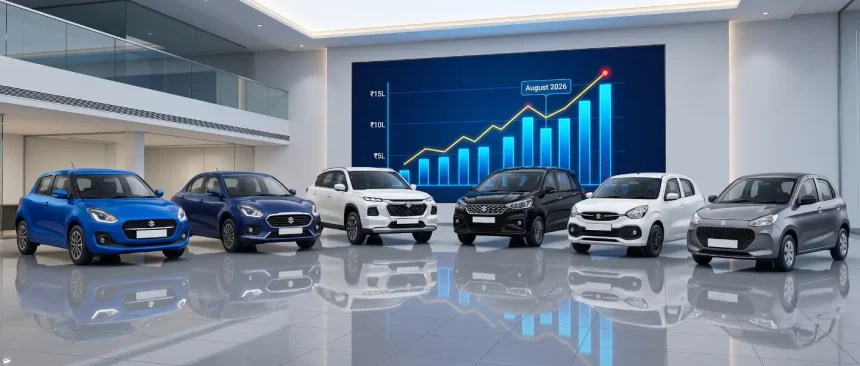
Why is Maruti Suzuki hiking the prices of cars in August 2026? Maruti Suzuki is going to hike the prices of its vehicles up to Rs. 30,000 in August 2026, citing rising costs of commodities and materials used to make them.
This is the automaker’s second price revision of the year, coming just two months after a similar hike in June. The bigger question isn’t really whether prices are going up. That part’s confirmed. It’s what this means for you if you’ve got a Maruti on your shortlist right now.
Why Is Maruti Raising Prices Again This Year?
Car prices rarely go up without a reason, and manufacturers usually point to a mix of cost and market factors behind such decisions. Here’s a closer look at what’s actually pushing Maruti to revise its prices twice within the same year.
Maruti Suzuki Price Hike August 2026: Two Hikes in Three Months
Maruti Suzuki has notified the stock exchanges that it will increase prices by Rs 30,000 per vehicle, based on the model type, starting from August 2026. There was a similar increase in prices in June 2026. It is the second price revision in the year 2026 for Maruti. Interestingly, even in January 2026, Maruti had plans to increase its prices but didn’t go ahead with it.
This very thing is what makes these successive price hikes look even more stark by comparison. At the tail end of 2025, Maruti had in fact reduced the prices of many of its vehicles as a result of the GST revamp of small cars, which really was great news for entry-level buyers then. This is probably the auto industry regaining some ground after all those months of having to maintain thin profit margins with two successive small price hikes instead of one major increase.
What’s Driving the Cost Pressure?
It appears that there has been consistency in the company’s argument behind both price increases. The primary cause of these actions is commodity inflation and rising production costs, which the company had been trying to absorb by improving efficiency for months without finding other options. In February 2026, Maruti was aware that prices needed adjustment because of rising costs of gold and silver, which are components of a few parts of its cars.
However, there is also a global perspective. Analysts emphasize problems in West Asia that affect international trade and increase production costs for automobile manufacturers due to disruptions in transportation and energy markets, making it harder for companies around the world to pay for raw materials. The news about price increases did not have an impact on the share price, as it even slightly rose after being publicly announced, which suggests that the cost adjustment was expected and usual for the company.
Which Models Are Likely to Get Costlier?
Not every car in a manufacturer’s lineup gets the same price bump, and the final figure usually depends on the segment and variant involved. Here’s a general sense of where the increase is likely to land across Maruti’s range.
Hatchbacks and Sedans
The Maruti Suzuki new prices model-wise breakdown hasn’t been officially detailed variant-by-variant just yet, but the increase is expected to cover the entire portfolio in some form. The Alto K10, Maruti’s entry-level hatchback, will likely see one of the smaller absolute bumps in order to protect its highly price-sensitive buyer base. The WagonR, a steady and consistent volume seller, should see a fairly moderate rise, while the Swift, one of the brand’s strongest all-round performers, could see a noticeably larger jump given how much demand it continues to pull in.
Sedan and premium hatchback buyers won’t really be spared either in this round of price revisions. The Baleno, sitting comfortably in the premium hatchback segment, is expected to see a mid-range increase broadly in line with its market positioning. The Dzire, India’s favorite compact sedan and a strong, consistent seller across both personal and fleet segments, is likely to land closer to the upper end of the hike, given just how much steady demand it continues to pull in every single month of the year.
SUVs, MPVs and CNG Variants
Maruti’s SUV and MPV lineup is generally expected to absorb some of the steeper increases in this latest round. The Brezza, a consistently strong performer in the compact SUV space, should see a fairly solid bump given continued nationwide SUV demand. The Fronx, the brand’s increasingly popular crossover offering, is likely to see a broadly comparable rise. The Ertiga, a long-standing mainstay in the MPV segment, and the Grand Vitara, Maruti’s flagship SUV, are both expected to see some of the higher absolute hikes given their relatively higher price points overall.
CNG variants are also expected to be very much part of this round, just as they were back in June’s revision too. Given how much CNG demand has grown across India in recent years, any increase here can genuinely catch buyers off guard since many were counting on CNG’s running-cost advantage to help offset the higher upfront purchase price. It’s also worth noting that base variants usually see smaller hikes compared to top-spec trims, so the exact final number depends heavily on which specific version you happen to be eyeing.
How This Compares to Tata, Mahindra, Kia, Hyundai Hikes?
Maruti isn’t hiking prices in isolation — this car price hike India 2026 story has played out across nearly every major manufacturer this year, driven by the same commodity and logistics pressures.
| Automaker | Recent Hike(s) in 2026 | Approx. Increase | Effective From |
| Maruti Suzuki | Second hike this year | Up to Rs 30,000 | August 2026 |
| Tata Motors | Second hike this year | Up to 1.5% (ICE + EV) | July 1, 2026 |
| Mahindra | Second hike this year | Avg. 2.7% on SUVs | July 10, 2026 |
| Kia India | Single hike | Up to 2% (full lineup) | July 1, 2026 |
| Hyundai | Second hike this year | Up to Rs 12,800 (approx. 1%) | June 1, 2026 |
Tata and Mahindra’s Price Hikes
Tata Motors Passenger Vehicles raised prices across both its ICE and EV portfolio by up to 1.5% effective July 1, 2026, marking its second increase of the year after an earlier 0.5% hike on ICE models back in April 2026. The gap between these two separate hikes suggests Tata has deliberately tried to spread out the overall impact on customers rather than pushing through one single large correction, broadly similar in spirit to how Maruti has approached its own two price hikes so far this year.
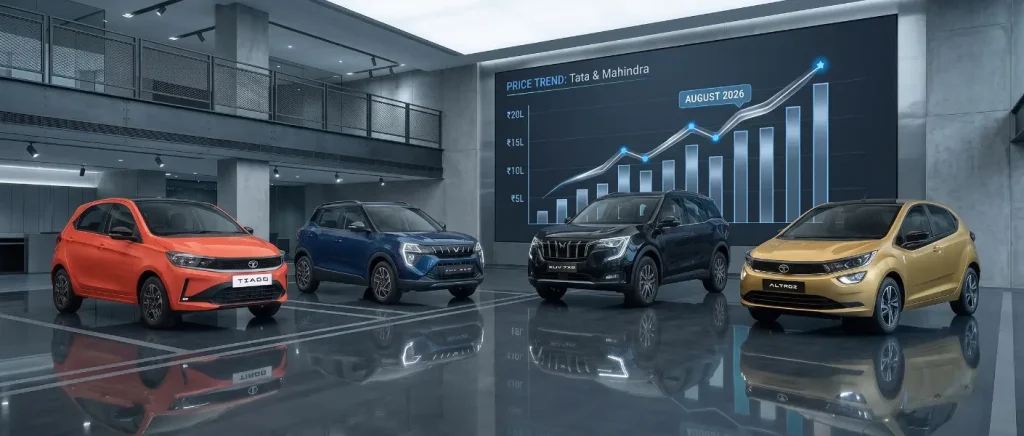
Mahindra & Mahindra took a slightly steeper route with its SUV lineup, announcing an average price increase of 2.7% effective July 10, 2026, on top of an earlier 2.5% hike on ICE SUVs back in April this year. Given Mahindra’s SUV-heavy portfolio and the consistently strong ongoing demand for models in that segment, the company appears far more comfortable passing on a larger share of rising input costs directly to buyers without worrying too much about it denting its overall monthly bookings numbers.
Kia and Hyundai’s Price Hikes
Kia India increased its prices by up to 2% for the entire range of models starting July 1, 2026, being the only company that implemented the price adjustment so far this year at the time of writing this report. Compared to its competitors, Kia’s relatively larger increase indicates that the firm preferred to absorb higher costs for a longer period before making adjustments,, whereas rivals such as Maruti, Tata, and Hyundai made several small adjustments throughout the year so far.
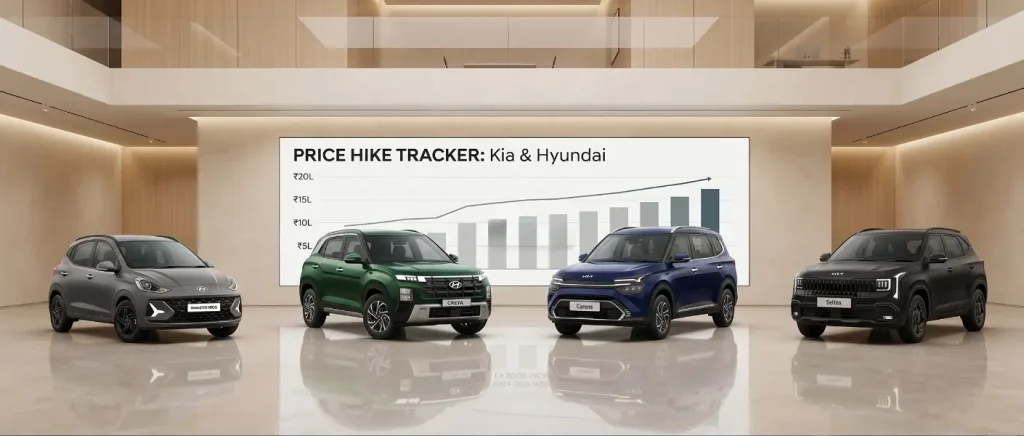
In my opinion, Hyundai had to revise its prices more often than any other competitor in 2026 so far. The company increased its prices by about 0.6 percent on January 1, 2026, and continued with another increase by up to Rs 12,800 on June 1, 2026. Increasing steel, aluminum, and commodity costs were the main driving factors behind those changes. There were even rumors that Hyundai had to increase its prices more often than most of its competitors throughout 2026.
Should You Book Before August, or Wait?
Timing a big purchase around a price hike always comes down to how close you already are to a decision. Here’s a simple way to think through whether booking now or waiting a bit longer makes more sense for you.
When It Makes Sense to Book Now?
If you’ve already finalized the model and variant you want, booking before the August hike actually kicks in is the more practical move to make right now. You could save anywhere from a few thousand rupees up to the full Rs 30,000, depending on the specific car, and on higher-priced models like the Grand Vitara or a top-spec Dzire, that’s genuinely not pocket change. Dealers usually let you lock in the current price with a small booking amount even if actual delivery happens a bit later.
It’s worth directly asking your dealership about their exact booking-to-delivery price protection policy before you pay anything at all, since terms can genuinely vary quite a bit from one showroom to another. Some dealers honor the price at the time of booking regardless of when delivery actually happens, while others only guarantee it if delivery occurs within a specific, pre-agreed window of time. Getting this confirmed in writing helps you avoid any unpleasant surprise later if your car ends up getting delivered after the new prices take effect.
When Waiting Could Work Better?
A Rs 15,000–30,000 difference on a car priced anywhere between roughly 5 and 15 lakh rupees usually works out to well under 1% of the total on-road cost. If you’re still deciding between variants, fuel types, or actively comparing Maruti against a rival brand, it’s generally smarter to take the time needed to get that decision right rather than rushing just to beat a price hike that amounts to a fairly small percentage difference in the overall bigger picture of car ownership.
It’s also worth remembering that Maruti Suzuki has already hiked prices twice this year alone, and going by that recurring pattern, another round isn’t entirely off the table before the year eventually ends. The festive season is also approaching fast, and dealerships typically roll out their own discounts, exchange bonuses, and attractive finance offers around that time regardless of any base price hike, and this could genuinely end up saving you more overall than what you’d lose by simply waiting a little bit longer to buy.
FAQs
1. How much will Maruti Suzuki car prices increase from August 2026?
A. Prices will go up by up to Rs 30,000 depending on the model and variant. The exact amount will vary across the lineup, with entry-level cars likely seeing smaller increases than higher-priced SUVs and sedans.
2. Which Maruti Suzuki models will be affected by the August 2026 price hike?
A. The hike is expected to cover the full range, including the Alto K10, WagonR, Swift, Baleno, Dzire, Brezza, Fronx, Ertiga, and Grand Vitara, along with CNG variants across these models.
3. Why is Maruti Suzuki increasing car prices again after June 2026?
A. The company says continued pressure from rising input costs, commodity prices, and inflation has made it necessary to pass on part of the cost burden to customers, despite trying to absorb it internally for months.
4. Is now a good time to buy a Maruti Suzuki car before the price hike?
A. If you’ve already decided on a model, booking before August could save you money. If you’re still comparing options or waiting for a better deal, the savings from beating the hike alone probably shouldn’t be your main deciding factor.
5. Are other car manufacturers also increasing prices in 2026?
A. Yes. Tata Motors, Mahindra, Kia, and Hyundai have all raised prices at least once this year, and some twice, citing similar reasons, rising commodity costs, input prices, and operational expenses across the industry.