What if the number that decides how much you pay at the pump every week isn’t really about the pump at all? What if it’s being decided thousands of kilometers away, in a boardroom in New York or a shipping lane in the Persian Gulf, long before that petrol reaches your tank? That’s exactly what’s playing out right now.
World crude oil prices have been all over the map from 2023 to 2026. Going from a war-induced high to an outright supply glut crisis, what’s on every single Indian car owner’s mind is this one very basic question: Is this going to make a difference in my fuel costs or not? Let’s cut to the chase.
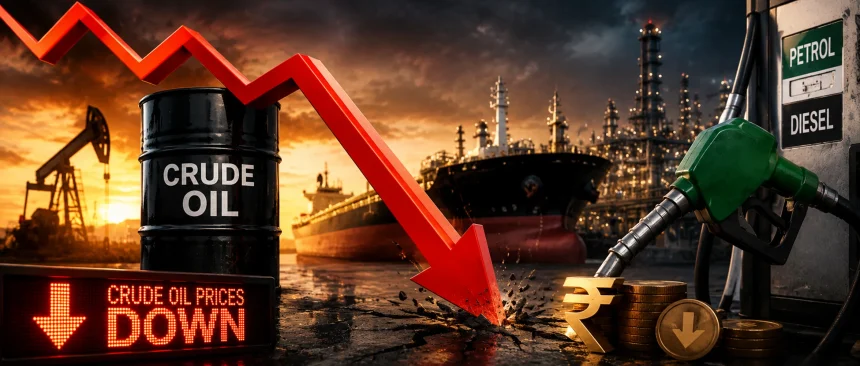
Crude oil price crash 2026: Is It Real?
However, this story has more turns than an Indian movie plot! Early 2026 marked another shocking moment, when the increasing tension between the US, Israel and Iran drove Brent crude to the price level of $138 per barrel, which was the peak not seen after the energy crisis in 2022, when the Strait of Hormuz – the bottleneck through which about 20% of global oil production flows was blocked for weeks. Yet the tables have turned:
- Brent crude averaged $85 a barrel in June 2026, down $22 in a single month and $32 off its April peak
- The US EIA now expects Brent to average around $74 a barrel in the third quarter of 2026
- Wall Street majors like JPMorgan and Goldman Sachs see Brent settling closer to $56–58 a barrel through the rest of 2026 and into 2027, thanks to a global oversupply that the IEA pegs at nearly 4 million barrels a day
In short: this crude oil price drop 2026 isn’t a blip. It’s a structural oversupply story, and it’s very real on the global stage.
Why Hasn’t Petrol Gotten Cheaper At My Local Pump?
This is the part that frustrates everyone, and fair enough. Here’s the honest answer: crude oil is only one ingredient in your fuel bill, and it’s not even the biggest one. Checking the petrol diesel price today in major Indian cities on 6 August 2026 tells its own story:
- Delhi: petrol ₹102.12/litre, diesel ₹95.20/litre
- Mumbai: petrol ₹111.21/litre, diesel ₹97.83/litre
- Bengaluru: petrol ₹110.82/litre, diesel ₹98.78/litre
- Chennai: petrol ₹107.76/litre, diesel ₹99.55/litre
- Hyderabad: petrol ₹115.69/litre, diesel ₹103.82/litre
These rates have barely moved in weeks, even while crude has fallen sharply from its April peak. Why?
- Taxes eat a huge chunk: Central excise duty plus state VAT together make up roughly 45–55% of what you pay at the pump. Crude, refining and freight together account for only about 35–45% of the retail price.
- Oil marketing companies are recovering old losses first: In early 2026, with the sharp rise in crude prices, the under-recovery in the case of petrol was about ₹26 per rliter, while in the case of diesel it was nearly ₹82 per rliter. With the fall in prices of crude now, OMCs are gradually building their margins.
- The government has room to raise duty instead of cutting it: When crude falls, it becomes financially convenient for the Center to hike excise duty rather than let pump prices drop. India has done exactly this before, more than once.
- Private players sometimes move first: Nayara Energy reduced petrol rates by ₹5 and diesel rates by ₹3 per liter from July 1, 2026, which was one of the first retail firms to provide some reduction, but the government-owned companies have not done the same.
So while the crude crash is genuine, the relief at your pump is, at best, partial and delayed.
What Does This Mean For Your Monthly Fuel Cost Car Ownership Budget?
If you’re one of the millions of Indians budgeting fuel as a fixed monthly cost, here’s what to actually expect over the coming months:
- Don’t expect to see an immediate decrease in costs. Even as crude continues to tumble toward the $55–60 per barrel levels expected in the fourth quarter of 2026 by most banks, Indian retail prices have typically been slow to react.
- The first hint that some reduction benefits consumers is visible in LPG, as OMCs have reduced the price of commercial cylinders of 19 kg by ₹183.50 from July 1, 2026.
- Diesel-dependent costs (transport, groceries, cab fares) may ease before petrol does, since diesel drives freight and logistics pricing across the economy.
- It is beneficial that cheap oil would bring a positive impact on India as a whole since oil imports amount to 85%. Thus, cheap oil will help improve the current account deficit, strengthen the rupee, and reduce inflation. Even if the effect won’t be evident immediately from your spreadsheet of fuel-related expenses.
- Keep an eye on excise duty announcements, not just crude headlines. That’s usually the real trigger for a pump price change in India, not the international rate itself.
Petrol Or EV: Which One Actually Saves You More Money In 2026?
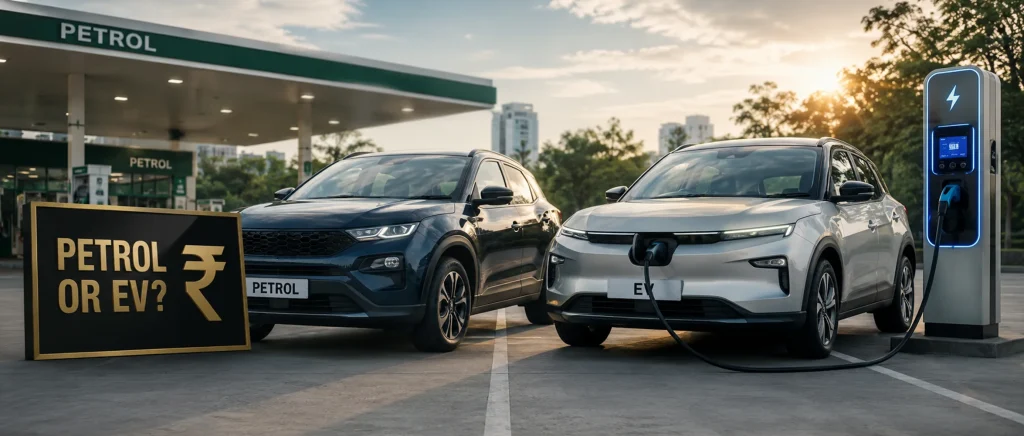
This is where the figures become truly impressive, and it makes sense to spend time looking at them before you buy another car. Consider a regular mid-sized gasoline hatchback/SUV with an actual city mileage of 15 kilometers per liter, with gasoline costing ₹105 to ₹110 per liter:
- That works out to roughly ₹6-7 per kilometer in fuel cost alone
Now compare that to an electric vehicle charged at home, where domestic electricity tariffs across Indian cities range from about ₹5.50 to ₹9 per unit:
- The mid-size EV cars run at a cost of 15-18kWh for every 100km, which amounts to about ₹1-1.5 per kilometer at home charge.
- Even relying on public DC fast chargers, priced around ₹18–25 per unit, running costs stay closer to ₹2-4 per kilometer, still cheaper than petrol
This is what makes the issue of EV versus petrol costs in 2026 an important one: an electric car would cost 60-80% less to drive per kilometer than a petrol car in India. Over 5 years, with 60,000-75,000 kilometers covered, that means savings of up to ₹2.5 lakh and ₹5 lakh in fuel alone. However, EVs are not a panacea for all:
- If you use your car less than 1,000 km each month, then your savings on gas may not compensate for the more expensive initial cost of EVs
- Long highway drives, patchy charging infrastructure outside metros, and still-uncertain resale values remain genuine EV drawbacks
- Regular petrol cars continue to be faster at refueling, cheaper initially, and more flexible for long distances
The calculations clearly point to making the switch to electric vehicles for the city-first drivers covering more than 1,200 kilometers each month and who have access to home charging facilities. However, for drivers making lengthy highway journeys or lacking a secure charging facility, gasoline remains the way to go.
The Bottom Line
A global crash in the price of crude oil does not necessarily guarantee a corresponding fall in the cost of petrol at the pump. But one thing that is certain is that the cost of running an electric vehicle is already substantially cheaper than that of a conventional fuel vehicle to such an extent that it is a question of not if but when a significant number of buyers in India will make the switch. And whichever side of the divide you find yourself, you would be advised to watch out for notifications on excise duties, rather than crude oil prices.
FAQ
1. Why are petrol and diesel prices in India not falling even though crude oil has crashed globally?
A. As taxes account for about half the retail price, and the oil marketing companies are at present using the low cost of crude oil to recoup losses incurred previously instead of reducing the cost per liter at the pumps.
2. What are the current petrol and diesel prices in major Indian cities?
A. As of early August 2026, petrol in Delhi is around ₹102/litre and diesel around ₹95/litre, while Mumbai, Bengaluru, Chennai and Hyderabad are all somewhat higher due to differing state taxes.
3. Is it cheaper to run an EV or a petrol car in India in 2026?
A. Yes, EVs are considerably cheaper to run, typically ₹1–1.5 per km on home charging versus ₹6–7 per km for petrol, making EVs the more economical choice for regular city driving.
4. Will crude oil prices stay low for the rest of 2026?
A. Most major forecasters, including JPMorgan, Goldman Sachs and the US EIA, expect Brent crude to hover in the mid-to-high $50s to $70s range through the rest of 2026 due to a global supply glut, though geopolitical risk could still cause sudden spikes.
5. Should I buy an EV or a petrol car right now?
A. If you drive over 1,000–1,200 km a month, have access to home charging, and plan to keep the car for several years, an EV will likely save you significant money; if you drive long distances frequently or lack charging access, a petrol car may still suit you better for now.